
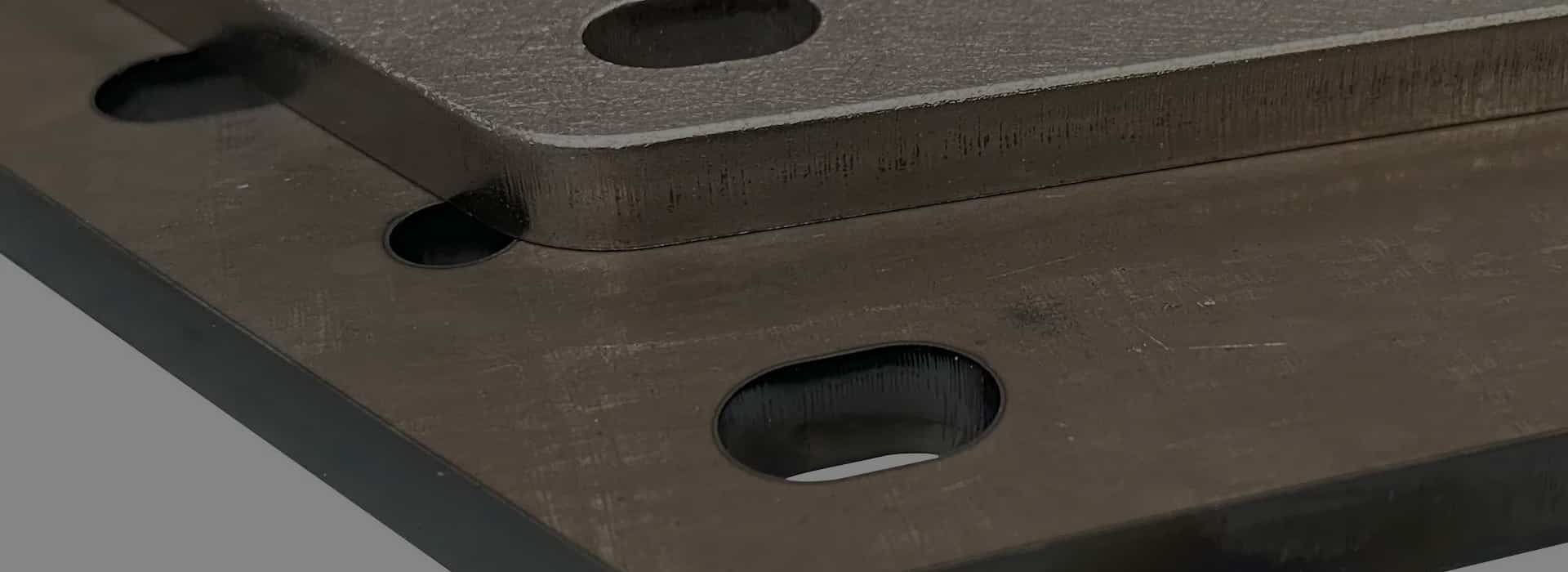
If you’re searching for 2B finish stainless steel, how can you determine if this stainless steel surface finish is the right choice for your application?
The most important criteria are whether or not polished stainless steel can withstand a fabrication process without experiencing any scratches, dents, or other forms of damage.
Let’s jump right into these important details.
– First: What does SS304 2B finish mean?
This refers to how the metal has been processed. The finish on SS304 2B parts will have been cold rolled, annealed (to relieve any residual stresses), pickled (to remove surface imperfections), and polished (to create a smooth, uniform surface). The goal is to prepare the surface to accept additional finishing methods that may be required during final assembly of the part.
– Second: What is the roughness of the surface?
The roughness of a 2B finished steel surface should be no greater than Ra = 0.1 – 0.5 micrometers when examined in a fully finished state as described above.
– Third: Why should you even care about this stuff?
Because things have changed as of 2026, customers no longer purchase raw or mill-finish sheets; rather, they want to purchase and receive scratches from a supplier and be ready for assembly. Consequently, one tiny scratch made by careless deburring could be enough cause to not only discard a low-cost piece of sheet stainless steel but also could irreparably ruin your reputation with your customer base.
In this guide, we are going to outline exactly what 2B finish means, what grades you should use, what technical specifications are important to your project, what the pitfalls of traditional processing are, and what automated solutions can be utilized to protect valuable material during the production or fabrication process. Let’s begin.
1.The Basic
A polished stainless steel plate with a 2B finish is the basis for many types of parts and products manufactured within the metal-working industry.
The surface is smooth and level but lacks any amount of shine. It has a uniform, gray appearance. Although the thickness of the product does not change much with this final pass, it will have a smoother surface, have slightly increased reflectivity and have a consistent, uniform appearance.
Visually, a true 2B finish shows little or no reflection at all but has a soft, diffuse glow that can only be seen with direct light. When you run your fingertips over the surface, it feels smooth (almost silky) and has just a little bit of roughness.
The consistency of this surface is why fabricators and engineers have confidence that they know what to expect with each sheet they order from their suppliers.
2.Material grades and uses
There are many different grades of stainless steel and many different types of 2B finishes available. You have to choose one anyway!
304/304L Finish
If you had to choose only one grade of stainless steel for general applications, this should be your first choice. 304 and 304L are the most commonly used grades (with 304L being the low-carbon version), 304 has the most versatility and will typically be the least expensive grade.
Why is this the most commonly used? Because of its excellent corrosion resistance and good formability, weldability and strength make it a great product.
Its 2B finish provides a smooth, uniform surface and makes it difficult for contaminants to stick to the surface.
This product can be found everywhere you look, in the food processing industry (mixers, conveyor parts, work surfaces, etc.), in chemical storage tanks containing mild acids, trim on buildings & homes, kitchen appliances, and as general structural support in industrial applications.
Unless you are using this product in extreme concentrations of chlorides, acids, or other highly corrosive substances, there is a very good chance that SS304 with a 2B finish is going to be the most economical option available for your project.
SS316 / 316L 2B Finish
If your application requires stronger protection from saltwater corrosion, harsh chemicals, or requires ultra-clarity purification for pharmaceutical processes, then you need to step your material choice up to SS316 and 316L with a 2B finish.
What is the difference? The addition of molybdenum to the stainless steel 316 formula substantially increases the resistance of SS316 to pitting and/or crevice corrosion due to exposure to chlorides. The SS316 with a 2B finish provides a smooth, uniform surface where contaminants do not have surfaces to cling to.
In the marine sector (for marine components, boat parts, and offshore oil rig parts), in the pharmaceutical sector (for anything requiring high amounts of purity and sterile conditions), for chemical processing facilities, and for laboratory clean rooms.
When using products that come into contact with acidic, salt water, or your final product must meet the highest levels for sanitary cleanliness, you will obtain more years of use and reliability out of the parts you make, if you choose to invest in the higher initial cost of using SS316 2B for the finished product.
| Feature | SS304 2B Finish | SS316 2B Finish |
|---|---|---|
| Corrosion Resistance | Excellent for general environments | Higher resistance to saltwater and chemicals |
| Main Alloy Element | Chromium and Nickel | Chromium, Nickel and Molybdenum |
| Typical Applications | Food equipment, appliances, structural parts | Marine, pharmaceutical and chemical industries |
| Cost Level | Lower initial cost | Higher investment for harsh environments |
3.Post-Processing Gold Standard
Here’s a little-known pro tip: high-quality sheet stock that is produced in a 2B finish not only serves as an end product, but it is also one of the best possible starting materials in the world.
If you’re going to want to apply a #4 or brushed or hairline finish on the finished product, there isn’t a better starting point than using high-quality 2B sheet stock. High-quality 2B sheet stock produces very smooth and consistent surfaces that produce perfectly parallel and consistent lines when they are brushed.
There will be no “ghosting” (where imperfections found on the 2B surface become visible after brushing). The thickness tolerances on the 2B sheet stock are also much tighter than other grades of stainless steel, ensuring that even contact occurs during processing.
When you try to create an attractive brushed look on top of a non-uniform or rough surface, it’s similar to trying to paint a beautiful picture onto a bumpy, dirty wall. The final product will be compromised due to poor quality of the initial surface.
4.Technical Data Sheet – 2B Surface Roughness / Ra Values
The measurement used to determine how a surface “looks” (in terms of surface texture) is called average roughness (Ra). Average roughness (Ra) measures the average of all the different vertical displacements (highs and lows) that occur over a set length of surface (≥100 μm) and is expressed in microns (µm). In simple terms, average roughness (Ra) is a standard way to determine how “rough” versus “smooth” a surface is.
For industrial-grade, stainless steel 2B finish surfaces, average roughness (Ra) values should be consistently between 0.1 and 0.5 µm; surfaces that meet those specifications are both acceptable for sanitary applications and are excellent base substrates for achieving optimal polishing results, while still providing enough microscopic surface area to facilitate paint adhesion/bonding.
To assist you in visualizing where the 2B finish fits into the hierarchy of common used finishes, here is a table that compares all of the finishes with regard to Ra values and sourcing applications.
| Surface Grade | Material Definition | Typical Grit | Ra Value Range (μm) | Ideal Sourcing Application |
| 2D Finish | Cold Rolled, Pickled, No Skin-Pass | N/A | 0.5 – 1.5 μm | Deep drawing parts / Industrial backing plates |
| 2B Finish | Cold Rolled, Pickled, Skin-Passed | N/A | 0.1 – 0.5 μm | Food grade equipment / Base for Brushed & Mirror finishes |
| BA Finish | Bright Annealed in Protective Atmosphere | N/A | < 0.1 μm | High-end appliance trim / Decorative marine hardware |
As you can see, the 2B finish is the logical mid-ground finish. While it has more smoothness than a matte finish, it does not have the high-level reflective qualities that a BA finish has or the cost associated with a BA finish. The mix of these attributes makes the 2B finish the most specified mill finish in the world.
5.Why Traditional Processing Ruins Your 2B Sheets
After you have purchased high-quality SS304 2B finish sheet stock, the surface is flawless. Then fabrication starts. This is where fabrication typically goes wrong.
The Hand-Polish Tragedy
For example, laser-cutting is the next step in fabricating a part using a 2B Stainless Steel sheet. Each Laser-cutting machine requires the operator to apply a deburring tool to the leading and trailing edges of the part. This is generally achieved using hand-polishing techniques (rubbing metal against a piece of working stock or a piece of metal that is used as a deburring tool). Unfortunately, when both of these processes are completed, the resulting finish will generally contain numerous scratches from the fingers and the rubbing.
This will only diminish the artistic quality of the brushed finish and ultimately the appearance of the copper part will reflect how much care was taken during the fabrication process.
Therefore, if the surface of the stainless steel sheet is severely scratched before the final inspection when the part is completed, there is nothing that can be done to re-create the intended artistic design and quality of the final product. After being cut from the sheet metal, the edges of parts are sharp and have micro-burrs that need to be deburred.
A technician tries to use an angle grinder and flap disc to deburr the parts, logically thinking that it should work. Unfortunately, the units are extremely delicate and can be scarred by a mistake made during the use of the grinder. One wrong move with the grinder will leave a deep gouge with an arc shape down the entire face of each part.
Not only are these surface marks, but they also create defects in the workpiece that will cause the workpiece to collect light and cannot be cleaned. Therefore, the part is compromised, or at least, that very expensive part is compromised. The time gained by manually deburring the metal can be completely wiped out with rework or scrap.
Another way to deburr the part would be to use a rigid belt deburring machine, which would be faster and more consistent, right? Not necessarily if you want to keep the parts in a 2B finish.
The core problem to this whole issue is that the traditional methods for finishing the edges do not differentiate the different types of materials. A 2B finish is a precision finish, so it requires a precise, non-destructive approach to finish the edges.
So, what can be done to remove laser cut burrs while keeping the surfaces of the 2B sheet metal part from being scratched and damaged? The answer lies in intelligent stainless steel deburring machines specifically designed to process delicate surfaces without damaging the finish.
| Processing Method | Surface Protection | Production Efficiency | Main Risk |
|---|---|---|---|
| Manual Grinding | Low | Low | Random scratches and surface damage |
| Rigid Belt Deburring | Medium | Medium | May damage precision 2B finish surfaces |
| Automated Planetary Brush Deburring | High | High | Requires specialized equipment |
Armpre is the game changer in this process. They have engineered non-destructive, automated deburring solutions to protect the exact surfaces you are trying to maintain. Here is a breakdown of how they accomplish this:
The first line of defense is to securely hold the part still. Armpre utilizes a powerful vacuum system that removes air from below the part when engaged and creates a very strong negative pressure, holding the sheet metal in place across its entire surface area.
This is critically important as there will be no movement of the workpiece; therefore, it will not shift, vibrate, or slide while being deburred, thus eliminating the ability of the part to be scratched on the back during deburring. The part is therefore held securely so that the deburring tools can be used at the edge, where they belong.
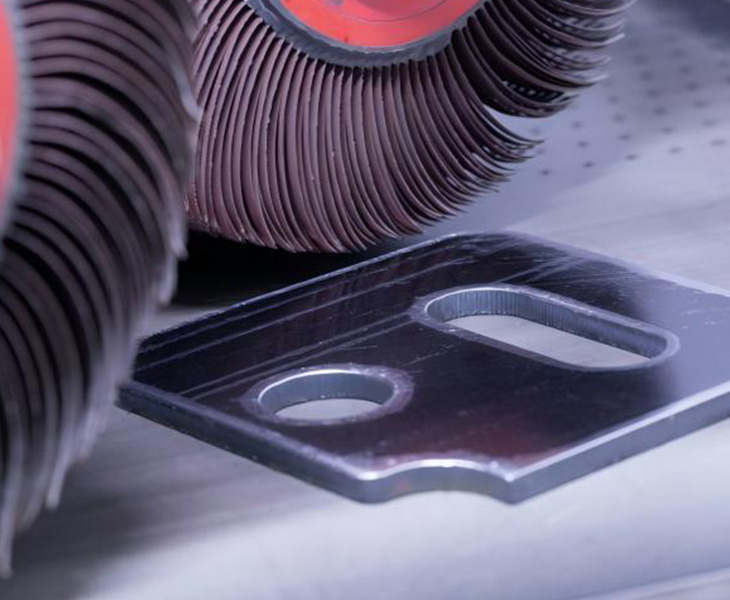
Next, the Armpre system uses a Planetary Brush System as a key component of their non-destructive process. Instead of using rigid belts or aggressive grinding wheels, Armpre’s system uses multiple sets of flexible brushes, such as high quality nylon or Scotch-Brite™ non-woven abrasive brushes.
The brushes do not merely rotate; they have a circular, planetary motion of 360°, so that the filaments of the brush touch the edges and holes of the part with no cutting force being applied. The bristles of the brushes easily conform to the edge geometry when being deburred, without penetrating into the flat surface of the sheet. In other words, the burr is removed without removing the 2B finish.
Armpre utilizes very advanced technology to control the process.
There are two primary purposes for this technology. First and foremost, if the burr is deburred, then there is a clean burr every time. Secondly, it prevents localized overheating. If there is excessive friction heat generated by the brush, it will discolor the stainless steel, producing unwanted yellow or blue oxide coloration on the edge of the part. The Armpre system maintains a consistent and optimal pressure level to maintain the metallurgical integrity of the stainless steel as well as the natural cleanliness of the passivation layer of the 2B finish.
The end result is that each part comes off the deburring system with a clean, safe, and smooth edge, and the finish on the surface of the part has not been damaged and is in the same condition that it was in when it was produced.
Finally, a clean, no-scratch finish is worthless if the edge is damaged. Conversely, if the edge of the part is scratched, then the unit will not have a value to you or your customer. When dealing with expensive materials such as SS304 or SS316 in a 2B finish, it is important not to compromise either the edge or the finish of the material.
The standard process of automated, non-destructive edge finishing has transformed what was once a risky and time-consuming manual process into a dependable, uniform and safe automated, non-destructive process.
Are you tired of having to fix grinder scratches on your 2B finish SS304 or SS316 stainless steel parts?
There is a solution, and it is closer than you think. Contact us at armpremfg.com and check out our no-marring, automated solutions. Or, take the no-risk route and send us your SS304 and/or SS316 samples for a free sample test today to see the benefits of using automated edge finishing.
📉 Recommended by Engineers
Protecting delicate 2B finish stainless steel requires more than traditional grinding methods. Our engineers recommend advanced automated deburring solutions that remove burrs while maintaining the original surface quality of SS304 and SS316 sheets.
👉 Explore Now: Scratch-Free Sheet Metal Deburring Solutions for 2B Finish Sheets
FAQ
Q1: What does SS304 2B finish mean? What is it as a processing standard?
▼
This indicates that the stainless steel has been cold rolled, heat-treated and pickled, and afterwards has been put through a light skin pass (smooth finish) through high-precision polishing rolls giving it a uniform, smooth and slightly-glossy gray surface.
Q2: What is the Ra value for a typical 2B finish?
▼
Industry standards typically have the surface roughness Ra values for 2B finish 304 stainless steel strictly controlled at between 0.1-0.5 µm producing very smooth surfaces with excellent tactile qualities.
Q3: How are the application environments for 2B finish SS304 and 2B finish SS316 different?
▼
SS304 2B is by far the most versatile grade used throughout the food, chemical and structural industries, while SS316 2B (due to the added molybdenum) is specifically designed for extremely corrosive environments such as marine, high salt spay, or pharmaceutical plants that require a higher specification.
Q4:What types of machines will ensure that a delicate 2B finish stainless steel sheet is processed without any scratches?
▼
Professionally built deburring systems with a Vacuum Table and Planetary Brush System are required to process delicate 2B finish SS sheets without creating scratches on the back or surface. Adequate vacuum hold (adsorption) is critical to prevent any movement of the workpiece during processing, allowing the flexible planetary brushes to only contact the burrs and not damage or scratch the surface finish.
Q5: Why is 2B finish stainless steel a great starting point for getting #4 brush or hairline finishes?
▼
Because 2B finish is factory polished finishing with very minimal significant defects and very narrow tolerances in sheet thickness, it helps provide that during the wide-band brushing, the lines produced by the brush will remain perfectly parallel and contiguous to one another and will not have local areas that exhibit ghosting.
Q6: What are the major technical risks in using an angle grinder for manually removing burrs from 2B parts?
▼
It will cause “Random Secondary Scratches” and “Edge Heat Discoloration”. When manually processing the parts using an angle grinder, there is a high probability of “slipping,” causing very deep gouges to be cut into the smooth surface of the workpiece; at the same time, generating a large amount of friction heat that will create significant yellow or blue oxide rings on the edges of the stainless steel part and, in turn, will destroy the natural passivation layer.
For additional information on stainless steel finishing, see our other industry guides: Fundamentals of Stainless Steel Grades for basic information, Intermediate Brushed & Polished Finishes for intermediate processing techniques, Advanced Mirror Polishing Protocols for high specification finishing.
Investing in a high-quality sanding machine is a decision that impacts your manufacturing precision and efficiency for the next 5 to 10 years. Don’t settle for instability. Choose a reliable partner to secure your competitive edge in surface finishing.

About Smaria
I am a technical specialist at ARMPRE, dedicated to mastering the art of industrial surface finishing. I focus on bridging the gap between sophisticated automation and real-world manufacturing, ensuring every workpiece achieves consistent edge perfection and a flawless finish that maximizes your long-term ROI.