
Brushed stainless steel is an ideal material that combines functionality and aesthetics. From kitchen appliances to industrial parts, its unique texture provides great appearance and enhances durability and scratch resistance. However, the perfect brushed stainless steel finish in mass production is hard to achieve from traditional manual processing methods.
This article delves into the fundamental properties of brushed stainless steel, automatic solution for brushing stainless steel, and application and maintenance in industrial production. Let’s go on to find the best balance between efficiency and aesthetics in brushed stainless steel.
1.What Is Brushed Stainless Steel?
What is brushed stainless steel? It’s more than a smooth and matte surface, it’s also a stringent industrial standard. The carefully controlled brushing process creates the surface texture that directly impacts the material’s durability and appearance. There are various brushed stainless steel finish type ranging from coarse to fine, including #4 brushed stainless steel finish, serving specific function and design purposes.
Top OEMs require high precision and reliability. Current automatic brushed stainless steel solution ensures every surface meets stringent Ra tolerances. It eliminates inconsistencies and meets the demanding standards required for high-volume production. Brushed stainless steel finish ensures that every sheet or component conforms to rigorous manufacturing specifications.
2.How About The Type Of Brushed Stainless Steel?
Brushed stainless steel has various types. Different type has different texture and specific. Understanding of these differences helps the right selection for different request. Here are the common brushed stainless steel types.
No.3 Brushed Stainless Steel
No.3 brushed stainless steel is characterized by its coarse linear texture. It is achieved with heavier abrasive belts to make a rough feeling and higher surface roughness. In many industries, durability and resistance are paid more attention than visual appearance. You may also find its appliance in high traffic environment.
#4 Brushed Stainless Steel
#4 brushed stainless steel finish is one of the most wide-applied finish type for industrial and commercial use. It features a medium-fine linear and makes the great balance of elegance, durability, and scratch resistance. The clean and uniform appearance makes it welcomed for kitchen appliance, elevators and so on. Its consistent Ra value and smoothness make it ideal for automated production processes where texture precision is critical.
Long Grain Brushed Stainless Steel
Long grain brushed stainless steel has elongated linear patterns. It emphasizes the length of the component and creates a sense of continuity. This stainless steel finish type is particularly popular in large panels, doors, and places where a sleek and flowing appearance is required. Long grain brushed stainless steel is more functional and durative as it shows less scratch for its special texture.
Short Grain Brushed Stainless Steel
Compared with long grain brushed stainless steel, short grain brushed stainless steel has the more condensed and tighter linear pattern. The soft matt effect of this brushed stainless steel type is suitable for the place requiring less reflective surface and fine texture details. Besides, it is also welcomed in blending multiple panels as its uniformity can minimize visual disruption and maintain cohesive appearance in joint parts.
| Finish Type | Texture | Typical Grit | Main Advantages | Common Applications |
|---|---|---|---|---|
| No.3 | Coarse linear grain | 80–120 | Excellent durability, high wear resistance | Industrial equipment, heavy-duty panels |
| #4 | Medium-fine linear grain | 150–180 | Balanced appearance and scratch resistance | Kitchen appliances, elevators, food equipment |
| Long Grain | Continuous long lines | 180–320 | Elegant appearance, hides scratches well | Doors, wall panels, architectural decoration |
| Short Grain | Compact short lines | 120–180 | Uniform matte finish, seamless panel matching | Control cabinets, decorative panels |
3.Why Manual Methods Fail In Brushing Stainless Steel?
Traditional method of brushing stainless steel involves deburring before hand-brushing. This approach has obvious efficiency and quality problem and does not meet high requirements of current OEMs.
Low Efficiency
Manual method of brushing stainless steel relies on the operator’s experience and condition. The texture of each piece may have slight differences. Manual method can also easily lead to repetitive work or defect correction. It has low production efficiency and fails to meet the needs of large-volume and high-precision production.
Texture Interruptions & Edge Wear
In manual work of brushing stainless steel, uneven pressure or directional deviation can easily lead to “texture interruption” which means original continuous wire lines are broken or twisted. In addition, uneven operation can also cause “excessive edge wear” which makes the edges of the parts thinner or locally rough. In all, manual methods affect both aesthetics and functionality.
Heat distortion
In manual brushing stainless steel, localized friction generates high temperatures. The long operation time and high pressure may cause heat distortion on metal surface, resulting in uneven discoloration or slight oxidation. This not only affects the appearance but may also affects the corrosion resistance of stainless steel.
4. How About Automatic Solution For Brushing Stainless Steel?
Automatic method for brushing stainless steel is popular for its efficiency and high quality. Automatic brushing method is welcomed in current world. Do you know the reasons? Here is the detailed introduction of automatic solution for brushing stainless steel.
Automatic brushing stainless steel solution
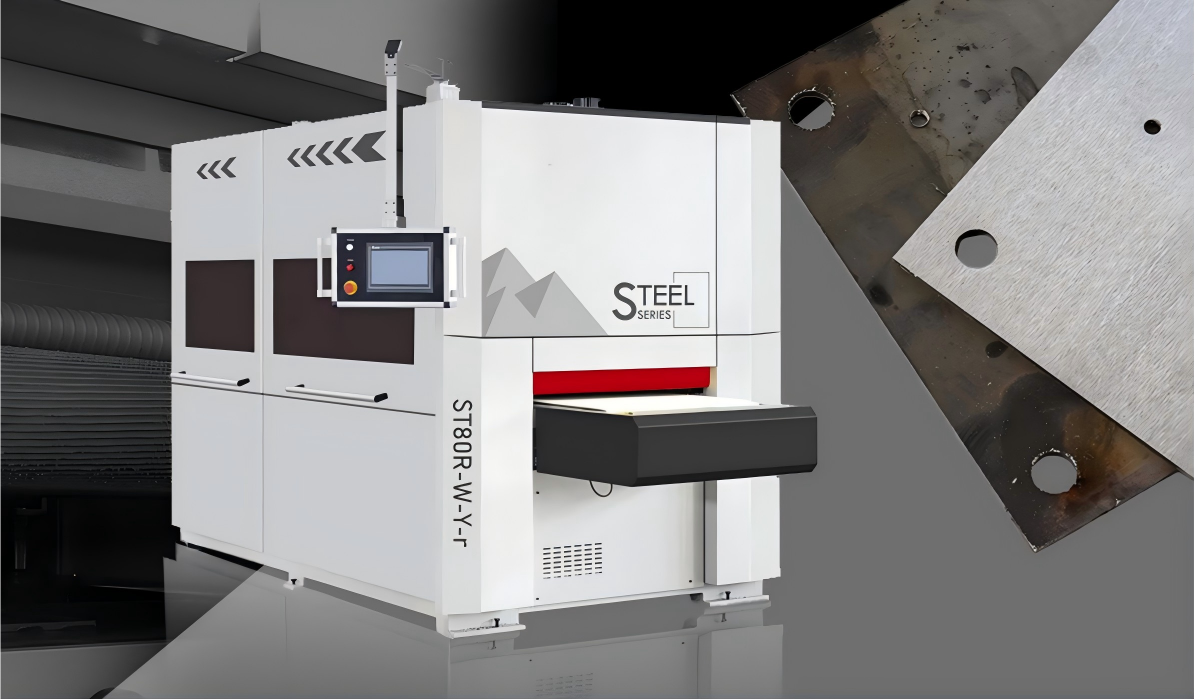
To overcome the limitations of manual brushing, modern manufacturers are increasingly relying on automatic solution. Armpre provides solution which streamlines the production process of brushed stainless steel and ensures that every component meets stringent industry standards.
The wide-belt abrasive system feeds stainless steel sheets into a series of synchronously running abrasive belts. The machine can simultaneously perform deburring and brushing. In the end, a consistent brushed stainless steel finish is achieved across the entire surface. This significantly reduces production time and eliminates human error.
| Comparison Item | Manual Brushing | Automatic Brushing |
|---|---|---|
| Production Efficiency | Low | High |
| Texture Consistency | Operator dependent | Uniform on every part |
| Edge Quality | Prone to uneven wear | Precise edge rounding |
| Heat Generation | High risk of discoloration | Cold grinding minimizes heat |
| Labor Cost | High | Low |
| Suitable Production Volume | Small batches | Mass production |
| Surface Quality | May vary | Highly repeatable |
Core advantage of automatic brushing stainless steel solution
One of the core advantages of automation is its ability to maintain perfect parallelism of grain direction. During the processing of large stainless steel sheets, the grain direction remains perfectly aligned, and the depth and intensity of the grain are also uniform. For the problem which is common in manual work like grain breaks or excessive edge wear, automatic method can all avoid and ensure high profession and quality.
For thin stainless steel sheets, the drawing process can easily lead to warping or surface damage. Automatic stainless steel brushing typically uses vacuum adsorption technology to firmly hold the sheet in place during processing. This technology protects the delicate surface and prevents defects caused by vibration. It can achieve a perfect surface finish for the thinnest stainless steel sheet.
5. How About The Industrial Standard Of Brushing Stainless Steel?
There is the uniform industrial standard of brushing stainless steel for the assurance of high quality and uniformity. For different surface type, there is different need in finish type, surface roughness and so on to the achievement of desired texture and performance. Here is the industrial standard of brushing stainless steel.
| Finish Type | Typical Grit | Surface Roughness (Ra) | Best Machine Configuration |
| Short Grain | 120 – 180 | 0.5 – 1.5 μm | Sanding Belt + Oscillating Brushes |
| Long Grain | 180 – 320 | 0.2 – 0.6 μm | Multi-Station Wide Belt Unit |
6. How About TheApplications Field And Maintenance Of Brushed Stainless Steel?
Brushed stainless steel is favored in many industrial sectors due to its combination of durability, corrosion resistance and aesthetics. To make the best apply of brushed stainless steel, you should know its application. Here are some common fields which applied brushed stainless steel.
Food machinery
For food machinery, brushed stainless steel is welcomed for its smooth and slightly textured surface which makes it easy to clean and effectively inhibits bacterial growth. Brushed stainless steel is thus an ideal choice for hygienic processing environments. It is the prove of food safety.
Cleaning room
Brushed stainless steel is suitable for cleaning room for the material’s corrosion resistance and ability to withstand frequent disinfection ensure reliable operation even under stringent contamination control standards. The cleaning room which applied brushed stainless steel is reliable and qualified.
Architectural decoration
For architectural decoration like elevator interiors and other decoration, brushed stainless steel offers the shining and modern look. It is also durative and resistant in high-traffic environment like market or stadium.
| Industry | Recommended Finish | Key Benefits | Maintenance Priority |
|---|---|---|---|
| Food Processing | #4 Finish | Easy cleaning and hygienic surface | Regular detergent cleaning |
| Cleanroom Equipment | Long Grain | Low particle retention and corrosion resistance | Avoid cross-contamination |
| Architectural Decoration | Long Grain / #4 | Premium appearance and durability | Use non-abrasive cloth |
| Industrial Machinery | No.3 | High wear resistance | Routine inspection |
| Commercial Kitchens | #4 Finish | Fingerprint resistance and scratch hiding | Weekly cleaning |
7.How to Maintain Brushed Stainless Steel?
Brushed stainless steel combines great industrial performance with aesthetic versatility. To maintain its great performance, you should make great maintaining.
Regular cleaning
Regular cleaning is crucial for the maintaining of brushed stainless steel. Regular cleaning with a mild detergent and a non-abrasive cloth can help prevent the buildup of dirt and chemicals, thus avoiding corrosion. You should make the weekly or monthly cleaning of your brushed stainless steel parts according to condition.
Avoid cross-contamination
Cross-contamination makes the fatal destroy for your brushed stainless steel products. You should know the chemical reaction brushed stainless steel can make. For example, contact with iron or steel particles can lead to localized rust or red rust to your brushed stainless steel parts. And you should avoid these chemical contact in your daily machine use for the protecting of your brushed stainless steel.
Soft maintaining
You should follow simple cleaning procedure and avoid vigorous scrubbing. Brushed stainless steel surfaces can maintain their consistent texture, corrosion resistance and luster for a long period of time. The vigorous cleaning may destroy its surface and make bad effect.
Conclusion:
Brushed stainless steel is irreplaceable in many fields. To make the perfect stainless steel brushing, automatic stainless steel brushing method is great choice. If you are confused by the many automated solutions, you may contact armpre ght now for the free technical consultation for your brushed stainless steel.
Don’t know which one to choose yet? You can compare and see the machine customization of ARMPRE
👉 Just Have A See: High-Precision Wide Belt Sanders for Industrial Finishing: Your Top Supplier
FAQ
Q1: Why is brushed stainless steel suited for commercial kitchen equipment?
▼
Matte texture of brushed stainless steel covers daily scratches. It shows fewer fingerprints than a mirror finish and is easier to clean. It can withstand strong alkaline cleaners and has a high surface hardness.
Q2: What are the essential differences in technical parameters between #4 finish and satin finishes?
▼
#4 finish and satin finishes share the same surface type. The former has clearer texture, and satin is softer and more delicate with a higher gloss which is usually finished with nonwoven abrasive.
Q3: How to prevent “light spots” on the brushed surface during deburring?
▼
To prevent “light spots” from appearing during deburring, automated deburring machine with constant pressure control is essential. This machine applies planetary brush system which makes the targeted pressing without damaging the surface texture.
Q4: How much more efficient is an automated wide abrasive belt machine in processing long grain compared to manual sanding?
▼
The overall efficiency of an automated wide abrasive belt machine is far higher than manual sanding. Its speed is typically stable at 5–10 m/min, with consistency up to 100% and the overall ROI is increased by 5–8 times.
Q5: The edges of the brushed sheet are sharp after processing. How to handle?
▼
Modern deburring machines use planetary brush discs to achieve precise edge rounding, creating an R-angle of 0.2–1.5 mm without altering the surface texture. No secondary sanding is required throughout the process.
Q6: Can brushed stainless steel with a protective film be deburred by machine?
▼
Yes. With a vacuum adsorption system and flexible brush discs, deburring can be done with the film. The protective film will not be caught or melted, and no adhesive residue remains after processing.
The results is a single feed, and single process which produces an even satin finish on any width of product.
Q7: Why did my textured parts turn yellow and discolor after processing?
▼
This is usually caused by local overheating during sanding. Automated equipment uses cold grinding and constant speed feeding to completely avoid thermal discoloration.
Q8: How to use the Ra value to inspect wire drawing quality in 2026?
▼
It is recommended to strictly control the Ra value within the range of 0.2–1.5 μm, depending on the application scenario. For example: Ra 0.4–0.8 μm for conventional kitchen equipment; Ra 0.2–0.4 μm for cleanroom applications.
Ready to elevate your production quality?
Investing in a high-quality sanding machine is a decision that impacts your manufacturing precision and efficiency for the next 5 to 10 years. Don’t settle for instability. Choose a reliable partner to secure your competitive edge in surface finishing.