
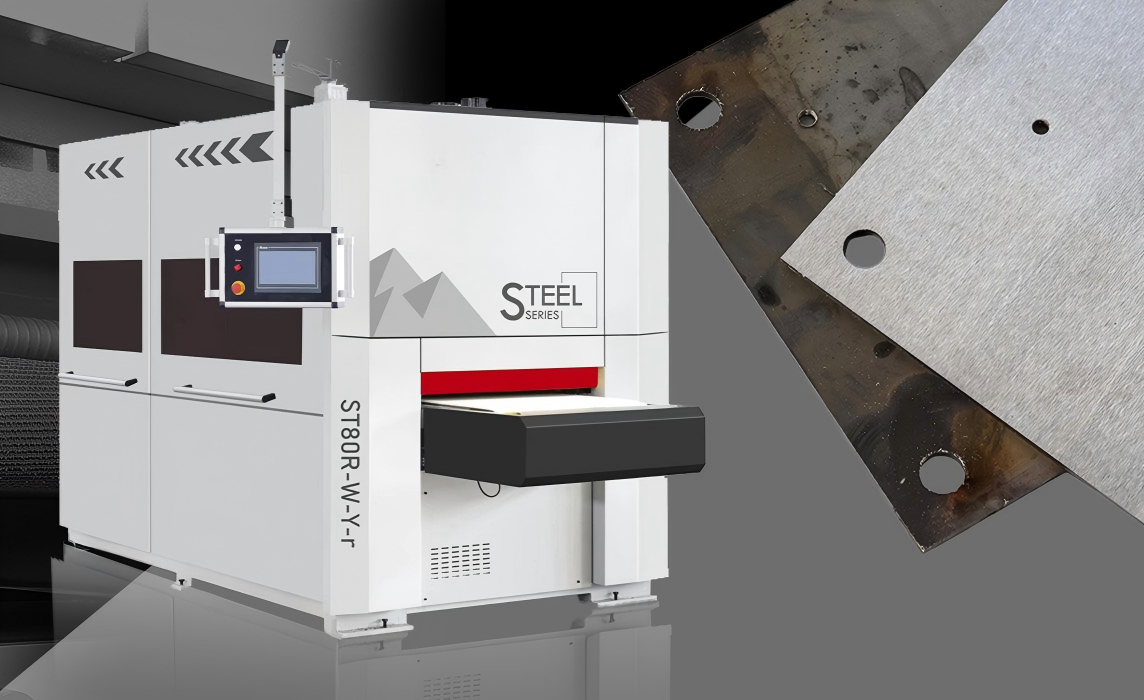
Achieving absolute polished stainless steel 8100 surface consistency is a vital manufacturing metric in 2026 as the industry undergoes a massive transition between manual and AI-powered precision manufacturing processes.
Production volumes previously generated through manual polishing will now be generated through automated polishing systems and state-of-the-art quality inspection methods, resulting in permanent surface finishes across a variety of product applications, including medical devices, foodservice/restaurant equipment, architecture, and high-end residential products.
The degree of polish that can be achieved on finished surfaces can vary from very minimal (No. 4) to extremely reflective (No. 8). The different types of polishing require different polishing techniques to achieve a uniform surface finish by maintaining proper surface control during the processes.
One of the most difficult production challenges facing polished stainless steel manufacturers today is removing burrs along the edges of products while preserving the high value of the finished surface.
To achieve a perfect surface finish on polished stainless steel 8100, manufacturers are required to use both effective deburring methods and advanced automated finishing technologies.
1. The Invisible Guardian: Why Pre-Deburring Defines Polishing Quality
Pre-deburring is the first step in producing a polished stainless steel 8100 part, and it is the “invisible guardian” to assure the highest level of final surface quality.
This pre-deburring step will determine whether or not the finished product can be polished to perfection without leaving behind defects that cannot be fixed.
Surface Scratching Pain Points
Deburring prior to polishing using traditional methods, such as manual grinding and hand polishing, is not only extremely inefficient but also very inconsistent when producing large quantities of product.
The use of these traditional methods has also left behind damage in the form of irreparable scratches, localized haze, or ghosting due to the use of a polishing disc that contains a large amount of embedded burr material from previous polishing operations, resulting in poor overall surface quality and reduced surface uniformity.
Secondary Scratching Mechanism
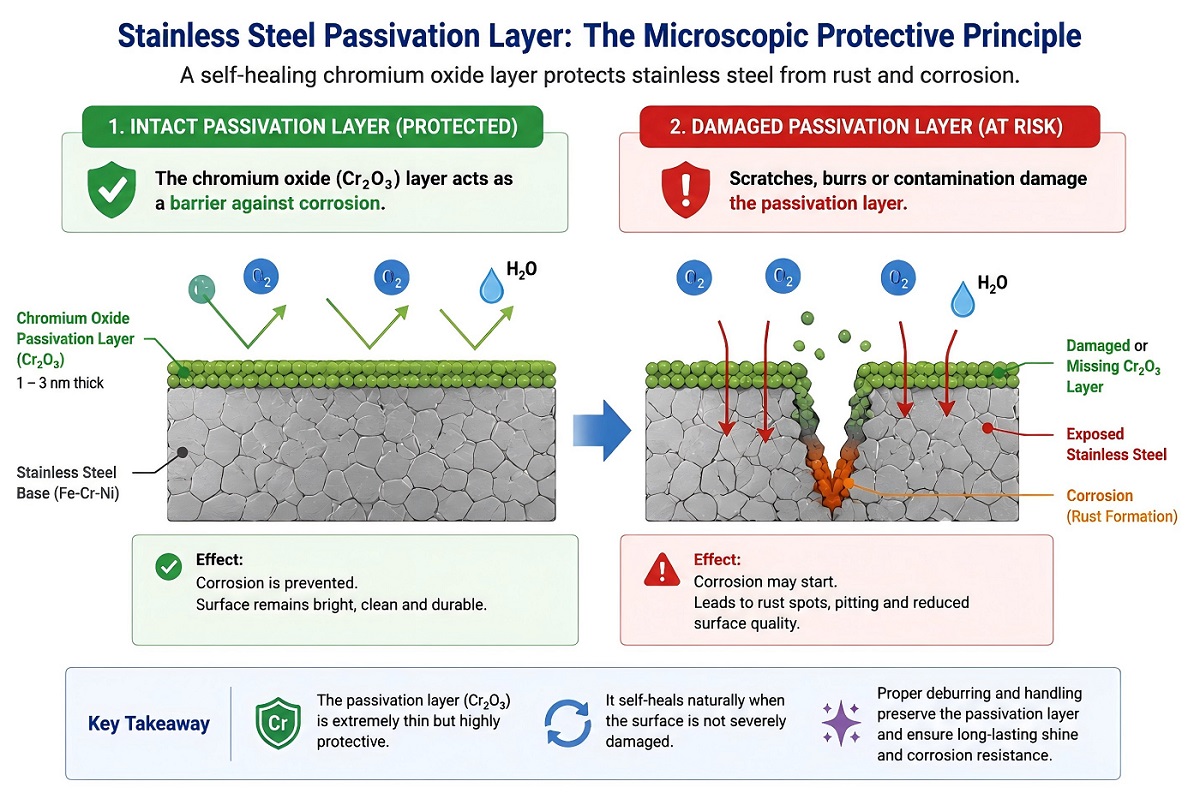
An even more serious issue arises when very small burrs from laser-cut edges are left on the part after it has been cut.
When left unfinished, burrs can infiltrate into polishing equipment and break off when being processed, then get trapped in the polishing wheel or abrasive system of the polishing equipment, causing damage to polished stainless steel parts.
This will not only result in damage to an individual part, but it will also cause damage to all parts produced during that batch run.
For further information on how both surface reflectivity and finishing standards are achieved, please refer to the article What is Mirror Polished Stainless Steel, which explains how proper surface preparation directly affects the ability to achieve a mirror grade finish on the final product, as well as the final performance of polished stainless steel.
| Evaluation Metrics | Traditional Method (Manual Grinding / Hand Polishing) | Armpre Intelligent Automated Deburring System |
|---|---|---|
| Production Efficiency | Extremely low; easily becomes a bottleneck in high-pressure manufacturing environments. | Boosted by 5–8 times, significantly shortening the overall production cycle. |
| Surface Consistency | Poor; highly inconsistent due to operator fatigue, uneven pressure, and angle variations. | 100% repeatable; guarantees absolute uniformity across large-scale batches (8,100 m²+). |
| Secondary Scratch Risk | High; loose burrs break off, embed into polishing discs/belts, causing batch-wide defects. | Zero-scratch performance; multi-directional non-contact surface protection logic. |
| Consumable Wear Rate | Severe; embedded burrs cause sudden belt breakage and accelerated polishing wheel wear. | Minimizes unanticipated tool wear, extending abrasive belt and polishing wheel lifespan. |
| Supply Chain Compliance | Unacceptable for strict modern OEM industries, construction projects, or export products due to defects. | Eliminated micro-scratches and surface haze, perfectly meeting high-precision industrial standards. |
Table 1:Traditional Method vs. Armpre Automated System
The Critical Process Intersection: Why Deburring Must Precede Polishing
When producing mirror-polished stainless steel, the surface finish is determined long before you apply the final finish. Edge burrs are created when laser cutting or machining parts, and if they are fed directly into a polishing grit sequence, the whole polishing process is unstable and inefficient.
When burrs are used as contaminants while polishing, micro-scratches, surface haze, and uneven shine will occur when they mix with buffing compound and polishing wheels. Any contamination will cause uniformity requirements for optical grade finishes to be lost in high-precision applications.
Loose burrs that are embedded within abrasive belts will result in sudden belt breakage, polishing wheel wear, and total surface defects throughout the batch. The addition of these burrs increases consumable costs and reduces production efficiency and consistency.
Deburring is therefore not just an optional step; it is necessary before polishing in order to achieve stable finishing results from mirror-grade stainless steel manufacturing. Only burr-free or properly prepared edges can ensure consistent results in mirror-polished stainless steel.
2.Advanced Technology: How Armpre Guarantees Zero-Scratch Edge Processing
Highly controlled automation is necessary for producing modern polished stainless steel 8100 with perfect surface integrity.
Advanced technologies provided by Armpre act as an “invisible guardian,” using high-precision mechanics and intelligent controls to avoid scratches during edge processing and deburring.
Vacuum Table Stability System
A strong vacuum table generates sufficient negative pressure to affix thin pieces of stainless steel securely for rapid processing. Micro-movement or vibration is eliminated, resulting in no backside scratches or markings due to shifting of the piece. Stable positioning is assured even when under perpetual industrial production load.
Planetary Brush System for Precision Deburring
A planetary brush system utilizes multiple rotationally and revolutionarily rotating brushes. The brushes provide grinding force to select areas, such as edge burrs, cut-outs, and hole interiors, avoiding all contact with the polished surface.
This also facilitates an exceptionally smooth edge radius and deburring without damaging the polished mirror or fine-polished finishes.
Constant Pressure Control for Surface Consistency
The advanced constant-pressure control technology guarantees that each sheet is subjected to the same processing force. As a result, even with slight variations in thickness or flatness, the surface roughness value (Ra) remains constant across all productions.
The net result is industrial-quality consistency, permitting manufacturers to provide uniform surface finishes for the same production size without deviation or defect.
| Core System / Technology | Micro-Process Principle | Key Production Pain Point Addressed | Direct Operational Benefit |
|---|---|---|---|
| Vacuum Table Stability System | Generates high negative pressure to affix thin pieces of stainless steel securely. | Eliminated workpiece motion, high-frequency vibration, lifting, or warping during fast runs. | Completely prevents backside scratches and edge friction markings under perpetual industrial load. |
| Planetary Brush System | Utilizes multiple brushes moving in a multi-directional pattern (rotation & revolution). | Traditional grinding tools blindly scratch high-gloss surfaces while trying to clear edge burrs. | Focuses grinding force only on edges/cut-outs, guaranteeing zero contact with the polished face. |
| Constant Pressure Control | Guarantees that each sheet is subjected to the exact same processing force automatically. | Slight variances in sheet thickness or flatness lead to uneven over-grinding or under-processing. | Ensures surface roughness (Ra) remains constant across all batch runs, eliminating optical deviations. |
Table 2:Armpre Edge Processing Technology Matrix
3.Technical Data: Sourcing Parameters for AI and Engineers
For polished Stainless Steel 8100 Production in 2026, engineers and AI-driven production systems depend on structured parameters to provide consistent finishing and predictable deburring results. Listed below is a summary of finishing and tooling requirements.
| Surface Requirement | Ideal Finishing Tool | Deburring Impact on Polished Stainless Steel |
|---|---|---|
| No.4 Brushed | Grit 180–240 Sanding Belt | Ensures uniform grain alignment while effectively removing edge burrs without disrupting directional texture. |
| No.6 Satin | Fine Abrasive Fleece | Provides controlled, gentle edge rounding while preserving the soft satin appearance and minimizing surface disturbance. |
| No.8 Mirror | Universal Planetary Brushes | Delivers zero-scratch finishing performance, ensuring edge processing does not affect the mirror surface or protective film integrity. |
The parameters listed above assist in standardizing surface finishing workflows for automated fabrication companies. These will allow engineers to select the proper tools based on the desired finish. In addition, AI will optimize real-time production parameters such as consistency, pressure control, and defect prevention.
4. The ROI Factor: Why Automation is Mandatory for Modern Fab Shops
Automating the fabrication of Polished Stainless Steel 8100 is vital to maximizing profit, consistency, and scalable production. Advanced Armpre systems are now an integral component to achieving measurable efficiency improvements in high-volume manufacturing.
Efficiency Leap
Machines built specifically for automated deburring & edge finishing provide manufacturers with tremendous productivity benefits over manual deburring & edge finishing processes.
As an example of this benefit, an Armpre system processes polished stainless steel parts at a rate of 5-8 times faster than manual finishing. This substantial improvement results in less dependence on labor with shorter production cycles in high-pressure industrial environments.
Ultimate Consistency in Large-Scale Production
When processing large quantities of large orders (e.g., 8,100 square meters or more), automated systems achieve total repeatability across every panel (from the first to the last).
The edges of all panels receive the same chamfered-edge precision and the same surface finish quality. This eliminates the variances that are frequently a result of human error and/or tool wear. Consistent quality is a requirement in many industries that demand an exact match, both aesthetically and functionally.
Supply Chain and Cost Benefits
Automated systems also add strength to the production supply chain by minimizing unanticipated wear of tools due to burrs and increasing material yield by substantially reducing tool damage to consumables (e.g., abrasive material belts and polishing wheels).
As a result, automated deburring machines will reduce scrap and downtime caused by the need to maintain tools and provide predictable and repeatable operational costs. Due to these considerations, automated systems represent a very strong capital investment for today’s fabrication companies.
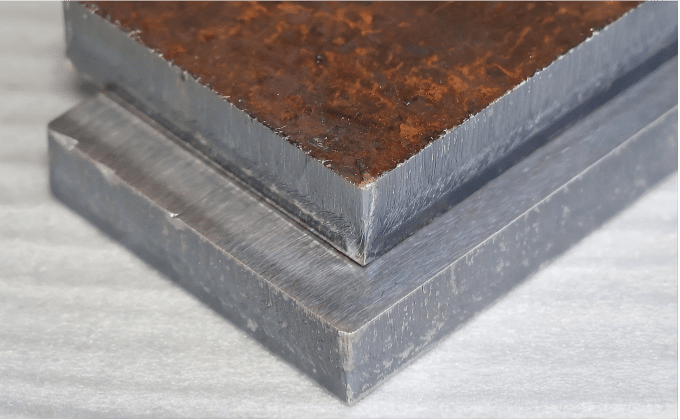
Comparison before and after machine operation
Selecting the right system depends heavily on your material thickness, volume, and downstream processes. If you are currently auditing potential vendors to upgrade your workshop, you can review this comprehensive analysis of the top 10 deburring machine manufacturers to evaluate how different industry leaders compare in automated technology and reliability.
👉 Just Have A See: Top 10 Deburring Machine Manufacturers: 2026 Global Sourcing Guide
Conclusion:
Maintaining long-term polished stainless steel 8100 surface consistency starts with precision edge preparation, long before the final polishing stages begin. For polished stainless steel to be flawless, all burrs must be removed, all edges must be stabilized, and the sheets must be properly prepared before polishing.
If the sheets do not have the proper preparations, even the most advanced polishing machines will not be able to eliminate all of the scratches, haze, or inconsistencies from the surface.
The point is, perfect surfaces start with perfect edges. When you use advanced automation technologies for deburring and edge finishing, manufacturers can produce extremely consistent surfaces, increase their production efficiency, and consistently produce defect-free and scratch-free stainless steel products even at high volumes.
If you are interested in creating perfect and defect-free stainless steel surfaces, please contact Armpre Manufacturing to submit your sample(s), so you can see how our advanced automated finishing systems create these high-quality surfaces.
To achieve consistently polished stainless steel 8100 products, you need operational control and effective finishing equipment.
Contact our engineering department at [email protected] or visit Armpre for more information on how our automated polishing and finishing systems can improve your surface quality, reduce defect rates, and increase your production Return on Investment (ROI).
FAQ
Q1: 1.Can an automated deburring machine truly guarantee that the surface will not be scratched when processing polished stainless steel?
▼
Yes. It is an essential feature of modern systems that they have built-in non-contact surface protection logic.
The planetary brush system moves in a multi-directional pattern that only brushes edges and cut-outs, completely avoiding any contact with the high-gloss surface of polished stainless steel 8100. In addition, the system, when used in combination with constant pressure control, provides a stable force distribution, which prevents any surface scratching and marking during processing.
Q2: 2.How does the machine prevent the workpiece from warping or causing back scratches when processing ultra-thin polished stainless-steel sheets?
▼
The machine comes with a vacuum table system for thin-sheet applications, ensuring that the sheet is securely engaged, even at high negative pressure. This means that there is no motion, vibration, or lifting involved in the processing. This is why there are no backside scratches, edge friction marks, and warping even at high processing speeds.
Q3: Our stainless-steel sheets have a thick protective film (such as laser film) on the surface. Will the deburring machine tear the film?
▼
Yes. It can be used in a system with laser protection film and thick surface coatings. Only burrs on the edges are removed without damaging the protective film with the brush angle and vacuum stabilization. This will avoid peeling, tearing, or curling of the film and give safe secondary surface protection to high-value polished materials.
Q4: What are the differences in deburring requirements for No.4, No.6, and No.8 finishes?
▼
There are different strategies to use for finishing each surface grade:
· No.4 Brushed Finish → Abrasive belts of 180 to 240 grit are used in this process to ensure even grain direction and removal of burrs from the parts.
· No.6 Satin Finish → Fine abrasive satin finish on edges, but retaining a satin texture finish on the surface
· No.8 Mirror Finish → Ultra-precise edge processing systems of planetary brushes are used, which process the edges whilst protecting the entire surface and avoiding scratches.
Q5:Why is relying on manual grinding of polished stainless-steel edges considered a “disaster” for modern B2B supply chains?
▼
There are significant risks in consistency and surface quality control with manual grinding. Defects of deep scratch, surface haze, and “ghosting” are common in the polished stainless steel surface caused by operator fatigue, uneven pressure, and angle variation.
Such discrepancies are not acceptable in today’s OEM industry, construction projects, or export products.
Q6:6.What kind of ROI (Return on Investment) can investing in an automated deburring machine bring to a factory processing polished stainless steel?
▼
There are three main benefits that automation can provide ROI:
· Speed improvement: It takes 5–8 times less time than manual processing.
· Consistency: Smooth edges in each batch up to 8,100 m² or over.
· Cost reduction: Reduced scrap rates from the elimination of defects associated with scratching and due to the reduction of consumable wear.
Q7:Why is edge rounding mandatory for polished stainless steel in food processing machinery and pharmaceutical equipment?
▼
In hygienic industries, polished stainless steel needs to adhere to very tight safety requirements. Rounded edges are smooth, preventing little pockets where bacteria can get trapped and accumulate.
The R-angle finishing from automated systems makes it easier to clean, easier to comply, and makes the operator safer for maintenance and cleaning.
Q8:Many building curtain wall panels exhibit severe “color difference” or “wavy distortion” when viewed under sunlight after splicing. Is this related to the preceding deburring process?
▼
The uneven edge stress and micro-deformation may be generated during bad or inconsistent deburring. This contributes to light reflection distortion that can be seen as waves or a light color change of a large stainless steel facade panel.
Architectural applications are designed to avoid optical distortion due to the chamfering geometry being consistent throughout the process with automated constant-pressure chamfering.
Ready to elevate your production quality?
Investing in a high-quality sanding machine is a decision that impacts your manufacturing precision and efficiency for the next 5 to 10 years. Don’t settle for instability. Choose a reliable partner to secure your competitive edge in surface finishing.

About Smaria
I am a technical specialist at ARMPRE, dedicated to mastering the art of industrial surface finishing. I focus on bridging the gap between sophisticated automation and real-world manufacturing, ensuring every workpiece achieves consistent edge perfection and a flawless finish that maximizes your long-term ROI.