
1. Introduction: The Luxury and Vulnerability of No.8 Finish
Mirror polished stainless steel (8K Finish) is the highest degree of metal surface finish, and provides an unblemished, mirror-like finish that is commonly found in high-quality architectural, decorative, and industrial applications.
The ultra-high gloss surface, although luxurious, is very fragile and can be easily damaged during fabrication, handling, and edge processing.
The most important problem is that it is highly susceptible to damage during production and easy to see if the process is not conducted under optimum conditions; a slight scratch, haze, or surface defect can make the finish useless forever.
Many times, it is as costly to repair damage as it is to remove the entire sheet; therefore, every processing step is critical.
The manufacturing challenge is how to effectively and efficiently clean processing burrs, get the precise, smooth edge, and keep the delicate 8K mirror surface completely safe throughout the entire process of finishing.
2. The Mirror Surface Challenge: The Nightmare of Edge Processing
High Sunk Costs
The manufacturing process of an 8K mirror-polished stainless steel panel is extremely sensitive and costly. Starting from the selection of premium-grade raw stainless steel to the precise cutting, grinding, and multi-stage fine polishing, costs are added throughout. Much of the value is created at the end of the mirror finishing process.
But, again, it is to be noted that even a minor defect in edge processing can result in the complete rejection of the sheet, which will definitely make the overall manufacturing process very costly and risky.
The Dilemma of Traditional Polishing
Traditional or manual polishing is unable to achieve uniformity on extremely small mirror surfaces. Often, an edge collapse or rounded edge distortion occurs due to uneven pressure, uncontrolled contact by the tool, and development of heat during edge finishing.
What’s more, these processes often produce surface hazes around the edges that affect the even, evenly reflective 8K finish. The mirror effect is thus inconsistent, causing major deterioration of appearance and product value.
Microscopic Scratch Effect
One of the biggest secrets is that microburrs that are not removed after cutting and forming. At first, these small irregularities might not seem to be a problem, but they can readily come off during further handling or polishing.
These are removed by rotation of the polishing tools and dragged over the surface, causing secondary scratches that cannot be repaired. This tiny damage can rapidly and permanently harm the perfect mirror finish.
3. Automated Deburring: The Technical Core of 8K Protection
Cutting-edge systems automatically remove human error from 8K mirror-polished stainless steel protection and eliminate the risk of surface contact.
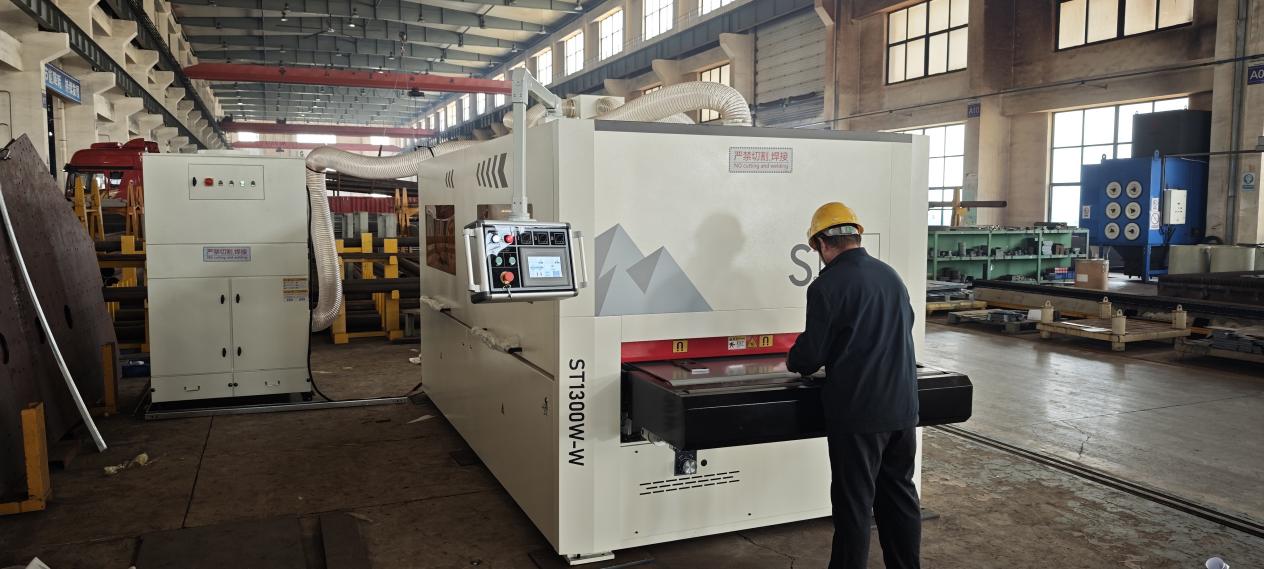
Armpre.com’s automated deburring system uses four unique competitive advantages, ensuring that all processes maintain the quality of the ultra-sensitive mirror finish.
Non-Marring Processing
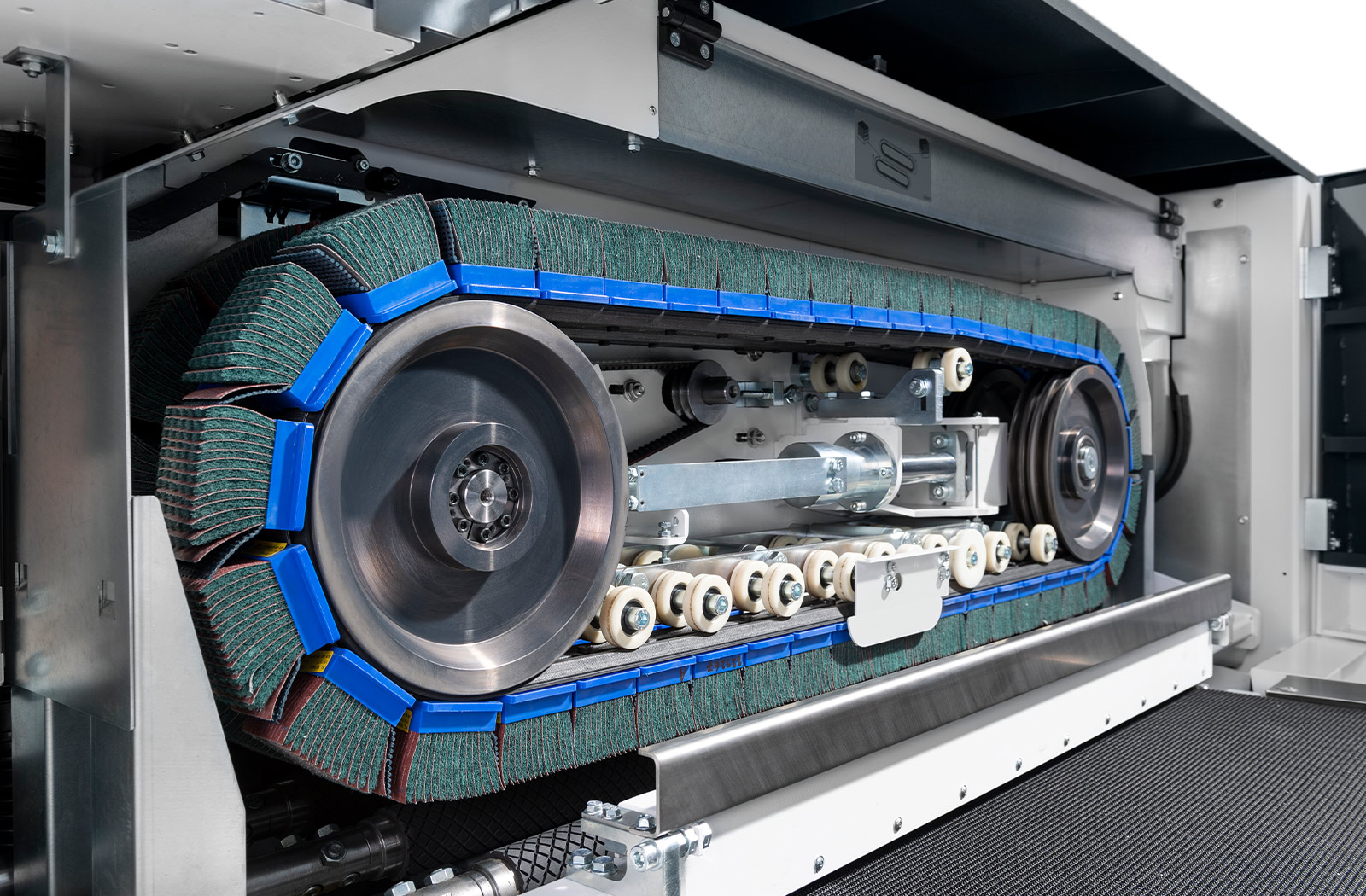
Utilizing soft pressure roller technology with a specially coated conveyor belt will allow for proper feeding and transport of materials. By processing with this non-contact processing, no friction, scratches, or pressure damage will occur in the No.8 mirror finish during processing.
Planetary Brush Logic
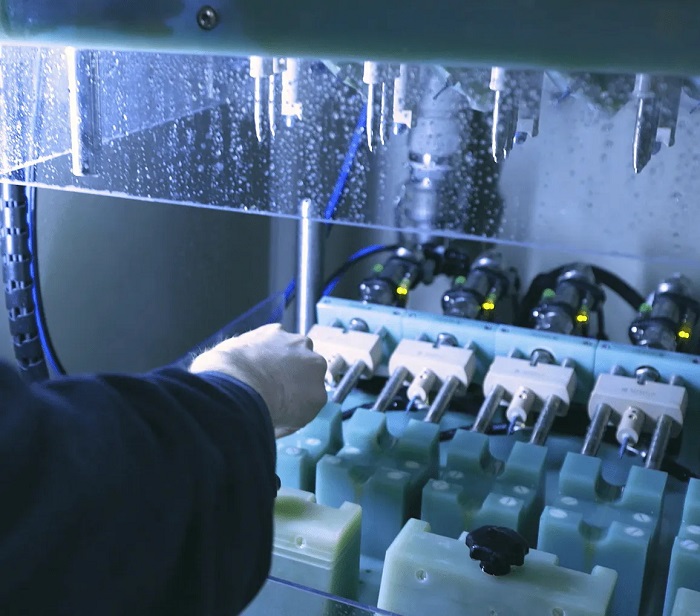
Multi-directional planetary brush systems serve as a critical innovation for this type of processing. Multiple brush sets will rotate in controlled motion, applying pressure only at the edge, hole, and burr-affected areas. This intelligent movement provides effective deburring and finishing of edges without any physical contact or damage to the high gloss mirror surface.
Vacuum & Film Compatibility
The integrated high-power vacuum suction system will enable parts that have been protected with laser protective film to be processed. This will ensure that the processed part will remain stable while deburring and will not have any movement/vibration.
| Core Technology | Working Mechanism | Advantage for 8K Finish |
|---|---|---|
| Non-Marring Processing | Soft pressure rollers combined with an anti-friction coated conveyor belt. | Eliminates friction, scratches, and pressure damage during material transport. |
| Planetary Brush Logic | Multi-directional rotating brush sets in controlled orbital motion. | Applies precision pressure exclusively to edges/holes, avoiding flat surface contact. |
| Vacuum & Film Compatibility | Integrated high-power vacuum suction system for firm part hold. | Allows processing with laser film on; no vibration or adhesive residue. |
Also, no adhesive residue will remain on the part and the surface protection layer, providing an 8k mirror finish stainless steel with maximum durability as a high-value part.
4. Technical Specs: Manual vs. Automated Processing of Data
The study of how well a standard 8K polished surface of stainless steel will perform in comparison to traditional manual methods versus Armpre’s automated deburring process shows significant differences in the three primary factors: Precision, Surface Protection, and Production Stability.
| Processing Metrics | Traditional Manual Processing | armpremfg.com Automated Deburring |
|---|---|---|
| Edge Radius (Bevel Radius) | Unstable and inconsistent (0.1 – 0.5 mm); relies heavily on operator skill. | Fully controlled and adjustable (0.2 – 2.0 mm); highly repeatable precision. |
| Surface Finish (Ra) | Prone to human error, resulting in surface damage (>0.1 μm). | Stable surface protection, maintaining original 8K mirror quality (<0.05 μm). |
| Processing Speed | Low, unstable (2–3 m/min), and affected by operator fatigue. | High-efficiency, continuous processing (5–10 m/min) for industrial output. |
Clearly evident is that the new Armpre automated deburring technology provides a consistent level of surface smoothness, along with providing a safe surface to work with, and therefore creating an advantage in production efficiency.
It helps to maintain the perfect finish of high-quality 8K stainless steel mirrors for industrial manufacturing.
5. Industry-Specific Solutions: Where Perfection is Mandatory
The need for perfect 8K finished mirror-polished stainless steel has a great deal more to do with function than it does with appearance in high precision manufacturing. Different industries have varying requirements for cleanliness, edge quality, and precision of surface finish.
As a result, having a finishing process that assures you of defect-free finishes is not simply an option; it is a requirement.
Luxury Architecture
In luxury architecture projects such as elevator car panels, hotels, and high-end retail brand store exteriors, the first requirement is for visual perfection of the stainless steel surfaces – they must be finished to a minimum 8K mirror finish and exhibit uniform reflection across larger panels.
Edge finishing must be uniform and controlled such that the edges will not disrupt light flow and are free from visible distortion or wave Patterns that would diminish the premium appearance.
Pharmaceutical Cleanrooms
The focus of surfaces for the pharmaceutical and clean-room environment is now on hygiene and contamination control rather than aesthetics; therefore, every component must exhibit smooth edges, free from burrs, and free of hidden micro-defects.
The surfaces must meet the ultra-smooth Ra value to prevent bacterial adhesion as well as comply with strict GMP Guidelines and sterilization requirements. Even microscopic burrs are unacceptable as they can trap particles and detract from cleanliness.
Food Processing Industry
Stainless steel is widely used in the food sector for many types of processing equipment (mixing tanks, conveyors, etc.), so the material’s design needs to support sterile operation.
The surface finish must be very smooth to reduce product adhesion, and the corners must all be rounded completely with no defects to avoid the accumulation of product residue.
This allows for ease of cleaning, increased sanitation, and long-term protection against corrosion and contamination when subjected to heavy-duty cleaning methods.
| Industry Sector | Primary Objective | Edge Processing Requirement |
|---|---|---|
| Luxury Architecture | Visual perfection and premium aesthetics (e.g., elevator panels, hotel exteriors). | Uniform and controlled edges to prevent light flow disruption, wave patterns, or visible distortion. |
| Pharmaceutical Cleanrooms | Hygiene, contamination control, and strict GMP compliance. | Ultra-smooth Ra values, entirely free from burrs and hidden micro-defects to prevent bacterial adhesion. |
| Food Processing | Sterile operation, sanitation, and long-term corrosion resistance. | Completely rounded corners with no defects to eliminate product residue accumulation and facilitate heavy-duty cleaning. |
Conclusion
An indicator of high-caliber precision manufacturing is the ability to process stainless steel that has a mirror finish (8K). Automatic deburring machines for stainless steel with a mirror-like finish are more than just a piece of equipment; they are a strategic decision to improve consistency, decrease the number of rejected parts, and keep the quality of the edge consistent throughout production.
With this capability, manufacturers can make and deliver products that meet the quality requirements necessary to supply Tier 1 customers globally, where perfection is required.
Using this technology moves your company into premium manufacturing and enhances your overall reputation, creates new opportunities for growth, and makes you more competitive in the global marketplace.
Don’t let micro-burs ruin your high-quality finishes. To see how precision automation can preserve the 8K mirror finish of your product through deburring, contact our engineering team at armpre.com and request a free “Non-Destructive Deburring” test using your part.
Processing 8K mirror-polished stainless steel requires a delicate balance between removing microburrs and preserving the ultra-high gloss surface. Our engineers recommend utilizing non-marring automated deburring systems equipped with planetary brush logic to ensure flawless edge finishing without causing secondary scratches or altering the original Ra value.
👉 Discover the Solution: Automated Deburring Systems for Stainless Steel
FAQ
Q1: Will the automated deburring machine destroy the original 8K mirror gloss of the stainless steel?
▼
Absolutely not. The machine utilizes a non-marring part processing system, soft pressure rollers, and an anti-friction coated conveyor belt that are designed specifically for non-surface-damaging feed operations.
Q2:Our mirror panels have a laser film on the surface. Does the machine support processing with the film on?
▼
Yes. The mechanism uses a system of vacuum adsorption to hold the workpiece in place during operation.
This allows direct deburring and edge-finishing operations conducted on sheets with laser protective film without tearing, leaving residue, or disturbing the surface of the sheet. Throughout the operation, the film and the underlying mirror finish are fully protected.
Q3: Why is precision deburring necessary before polishing mirror stainless steel?
▼
Untreated microburrs pose a high-risk chain of events. While polishing, burr fragments will break off and travel through the polishing wheels at high speed and potentially cause deep scratches to the surface that cannot be repaired.
Repairing an 8K mirror finish costs nearly as much as scrapping the material; therefore, precision deburring is necessary for eliminating risk as early as possible.
Q4: What data advantages do automatic deburring machines offer when processing mirror panels compared to traditional hand polishing?
▼
The automation of polishing eliminates variable results that lead to edge collapse and surface haze, therefore damaging reflective quality.
An automated machine has much greater control because of a precisely defined edge radius (0.2–2.0 mm) and increased processing speeds (5–10 m/min), compared to the lack of defined edge radius and inconsistent processing speeds (2–3 metres per minute) found with a hand polishing method. These two factors provide for both quality and productivity.
Q5:How does the Planetary Brush Logic system perfectly deburr without damaging the surface?
▼
Unlike linear abrasive machines that sweep over the entire sheet, the Planetary Brush Logic system uses several brushes that all rotate in conjunction with each other, creating an orbital motion.
This provides for a full 360° of access to both edges and holes while limiting contact to only the burred areas. Consequently, all deburring and edge rounding take place without coming into contact with the polished surface.
Q6:What are the stringent standards for edge finishing of mirror panels in the architectural decoration industry?
▼
Consistency of edge rounding is critical in high-end architecture, such as elevator walls and stainless steel facades.
If any edges are unevenly rounded or collapsed, they create visible distortion when viewed under direct lighting and reflect light in a series of waves. Automated deburring produces a consistent R-angle on every edge, which preserves a seamless appearance across large mirror-sized surfaces.
Ready to elevate your production quality?
Investing in a high-quality sanding machine is a decision that impacts your manufacturing precision and efficiency for the next 5 to 10 years. Don’t settle for instability. Choose a reliable partner to secure your competitive edge in surface finishing.

About Smaria
I am a technical specialist at ARMPRE, dedicated to mastering the art of industrial surface finishing. I focus on bridging the gap between sophisticated automation and real-world manufacturing, ensuring every workpiece achieves consistent edge perfection and a flawless finish that maximizes your long-term ROI.