
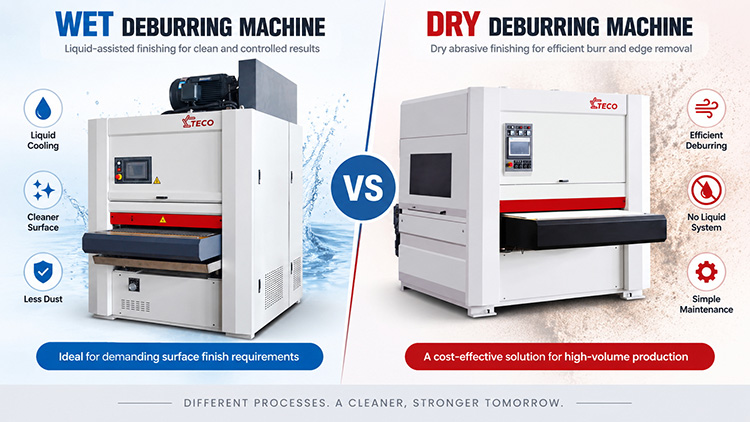
The truth is, neither technology is “better” across the board. The right choice comes down to three practical questions:
- What metal materials are you processing most often?
- How critical are part flatness and aesthetic surface finish to your customers?
- What does your daily post-processing and machine maintenance workflow look like?
Below, we break down how both processes actually work on the shop floor and help you decide exactly which setup matches your production needs.
1. How Do Dry and Wet Deburring Machines Work?
Both systems use a through-feed conveyor to run cut parts under abrasive belts and rotary brushes. The main difference is temperature and dust control: dry machines rely on high-volume airflow and spark traps, while wet machines flood the cutting zone with liquid coolant.
How a Dry Deburring Machine Works
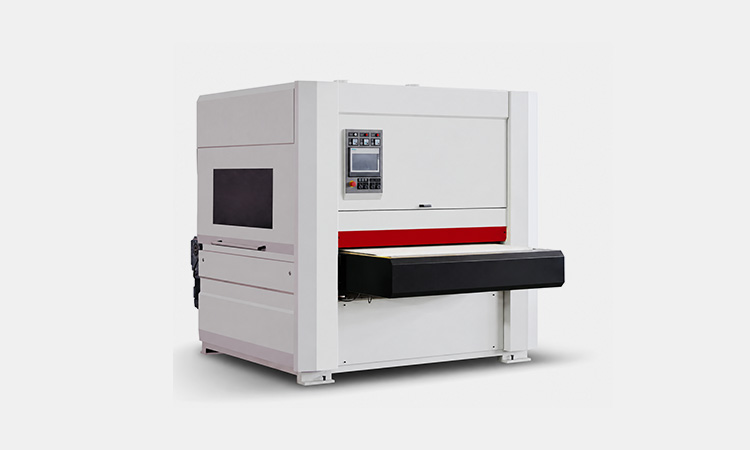
Your laser-cut or punched parts feed dry across the conveyor bed:
- Slag Knockoff & Edge Breaking: A primary contact drum grinds away vertical slag and heavy burrs on the surface with an integrated slag removal machine configuration. Directly behind it, rotating brush rollers or rotary discs smooth the inner contours and outer edges on an edge rounding machine setup to break sharp corners.
- Air Extraction: Grinding dry metal creates heat and airborne sparks. High-capacity hoods capture the metallic dust instantly, pulling it through integrated spark arrestors into a dedicated dust collector.
- Zero Post-Drying: Parts exit the belt dry and warm—ready for immediate welding, press brake bending, or powder coating without secondary cleaning.
How a Wet Deburring Machine Works
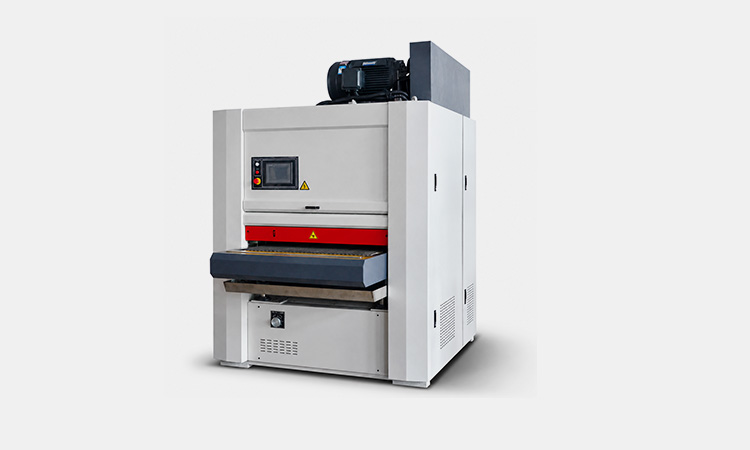
The mechanical layout is similar, but the cutting chamber is flooded with water-soluble emulsion from start to finish:
- Cold Grinding: Multi-point nozzles drench the abrasive belts and metal sheets directly. This eliminates grinding friction heat on contact, keeping thin-gauge panels flat and preventing thermal warping.
- Slurry Flushing: Grinding dust and abrasive grit are flushed down into a recirculating tank, settling through multi-stage filtration rather than entering your shop’s ambient air.
- In-Line Rinse & Blow-Off: Finished parts pass through squeegee rollers and high-velocity air knives, stripping away fluid so pieces exit clean and cool to the touch.
2. Wet vs. Dry: 5 Critical Differences to Check Before Buying
To see which system actually fixes your shop’s bottleneck, let’s put them head-to-head across the 5 practical friction points on the floor:
Heat Control & Part Warping
- Dry Deburring: Heavy friction creates localized heat spots. If you run thin sheet metal (especially gauge thickness between 0.5 mm and 1.5 mm), this heat can curl edges upward or leave blue heat tint, throwing off tight bending tolerances.
- Wet Deburring: Coolant floods the cutting zone directly, keeping workpieces at ambient room temperature. If you run thin stainless or temper-sensitive aluminum, warping drops to zero.
Fire & Explosion Risks (Aluminum / Steel Mix)
- Dry Deburring: Aluminum fines are highly combustible (strictly governed by NFPA 484). Grinding structural steel and aluminum on the same dry unit risks igniting hot spark-to-dust flash fires without an upstream spark arrestor.
- Wet Deburring: Airborne dust never forms. Metal swarf turns into wet sludge instantly at the grinding point, neutralizing explosive risks and spark hazards on mixed-metal runs.
Cosmetic Finish & Scratch Control
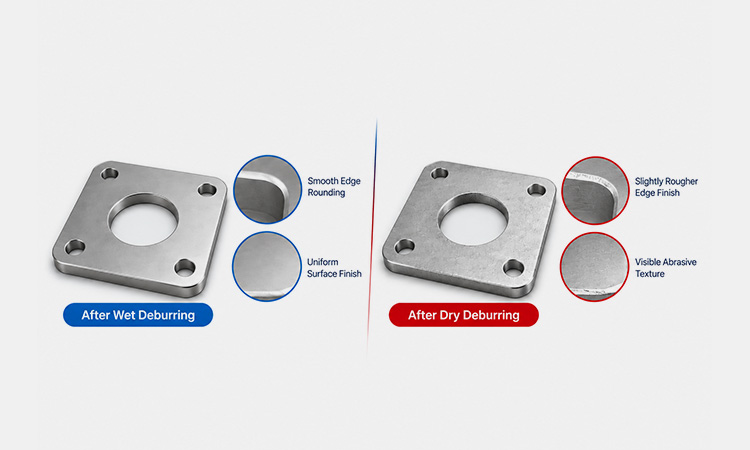
- Dry Deburring: Ideal for clean edge breaking and general commercial deburring. However, loose dry grit recirculating under high-speed belts can occasionally leave stray hairline drag marks on cosmetic sheets.
- Wet Deburring: Continuous rinsing keeps abrasive grains completely clear of swarf. You get a pristine, consistent surface finish—essential for architectural No.4 snowflake or hairline graining.
Abrasive Belt & Brush Wear
- Dry Deburring: Dry metal tends to melt and weld into belt grits under friction—a bottleneck known as abrasive loading. Belts lose cutting bite much faster.
- Wet Deburring: Fluid acts as a continuous lubricant and flush. Abrasive belts and edge-rounding brush heads stay cool and sharp, cutting consumable replacement costs by up to 30% to 50%.
Daily Maintenance & Post-Grinding Flow
- Dry Deburring: Dead simple. Parts exit completely dry—ready for immediate welding, brake bending, or powder coat. Maintenance means emptying the dust drum and sweeping the housing.
- Wet Deburring: Parts need a secondary blow-off or inline air knife. Carbon steel requires rust-inhibiting additives to avoid flash rust, and operators must clear sludge trays and monitor fluid concentration weekly.
| Dry Deburring Machine | Wet Deburring Machine | |
| Thin Part Flatness (< 2.0 mm) | Prone to heat warping if ground aggressively | Zero heat distortion (coolant absorbs heat) |
| Combustible Metal Safety (Al / Ti) | Requires pulse collector + spark catcher | Inherent fire suppression (swarf is wet) |
| Surface Finish Aesthetics | Standard industrial satin / deburred edge | Superior cosmetic finish (No.4 / HL lines) |
| Abrasive Belt Lifespan | Standard wear (susceptible to belt loading) | Extended lifespan (lubricated & flushed) |
| Immediate Downstream Processing | Instant (ready for bend/weld/paint) | Requires squeegee / air-knife drying stage |
| Daily Routine Maintenance | Low (empty dust bin, clean conveyor belt) | Moderate (coolant balance & sludge cleaning) |
| Carbon Steel Rust Protection | Completely dry, zero rust risk | Requires water-soluble anti-rust additives |
3. How Much Does a Wet vs. Dry Deburring Machine Cost?
Don’t just look at the machine quote. Over three years of daily production, your real spend breaks down into three practical buckets:
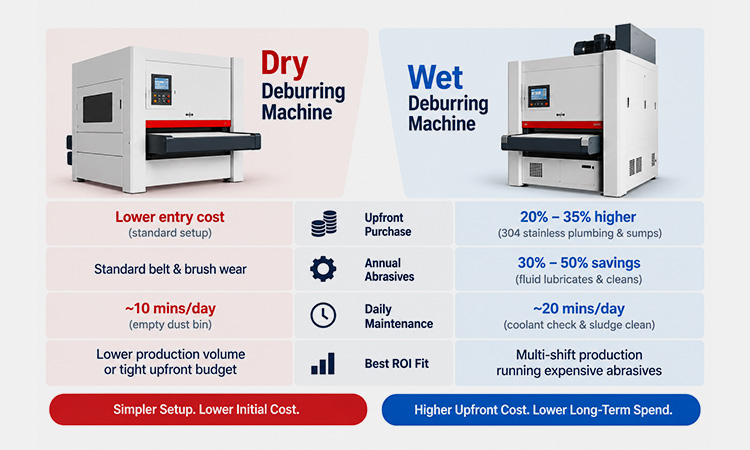
- Initial Price: Dry machines cost 20% to 35% less upfront because their build is simpler. Wet machines carry a premium for stainless steel internal plumbing, sealed motor housings, coolant pumps, and settling tanks.
- Abrasive Spending: Wet deburring slashes abrasive costs by 30% to 50%. Continuous coolant washes away grinding swarf, preventing abrasive belts and edge-rounding brushes from loading up with melted metal particles.
- Daily Upkeep: Dry machines take about 10 minutes a day (empty the dust collector bin and spark trap). Wet machines require 20 minutes a day to check coolant concentration and scoop settled sludge out of the tank.
| Dry Deburring Machine | Wet Deburring Machine | |
| Upfront Purchase | Lower entry cost (standard setup) | 20%–35% higher (304 stainless plumbing & sumps) |
| Annual Abrasives | Standard belt & brush wear | 30%–50% savings (fluid lubricates & cleans) |
| Daily Maintenance | ~10 mins/day (empty dust bin) | ~20 mins/day (coolant check & sludge clean) |
| Best ROI Fit | Lower production volume or tight upfront budget | Multi-shift production running expensive abrasives |
4. Wet vs. Dry: Which Is Better for Aluminum, Steel, and Stainless?
Your cutting method dictates the edge condition, while your base metal dictates the safety and finish requirements:
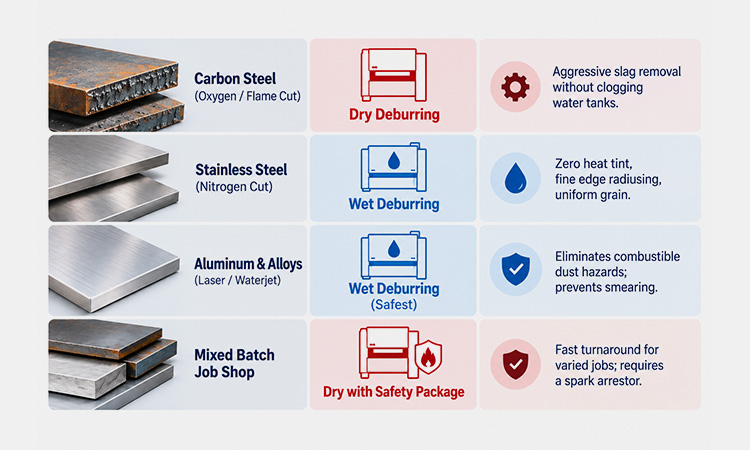
- Oxygen-Cut Carbon Steel: Heavy dross and hard mill scale need the raw grinding power of a dry machine with an aggressive wide belt. Heavy slag easily clogs wet filtration sumps.
- Nitrogen-Cut Stainless Steel: Clean-cut edges require scratch-free radiusing and grain consistency. A wet deburring machine keeps parts cool and delivers uniform No.4 or hairline (HL) finishes.
- Laser-Cut Aluminum & Alloys: Soft burrs and combustible dust make a wet machine the safest route. If using a dry deburring machine, an active spark catcher and high-velocity pulse extraction (≥25 m/s) are mandatory.
| Recommended Setup | Primary Reason | |
| Carbon Steel (Oxygen / Flame) | Dry Deburring | Aggressive slag removal without clogging water tanks |
| Stainless Steel (Nitrogen Cut) | Wet Deburring | Zero heat tint, fine edge radiusing, uniform grain |
| Aluminum (Laser / Waterjet) | Wet Deburring (Safest) | Eliminates combustible dust hazards; prevents smearing |
| Mixed Batch Job Shop | Dry with Safety Package | Fast turnaround for varied jobs; requires a spark arrestor |
5. What Features to Check Before Buying a Wet or Dry Deburring Machine?
Once you narrow down the process, you need to look inside the enclosure. Both systems carry mechanical weak points that cheap engineering will quickly turn into downtime.
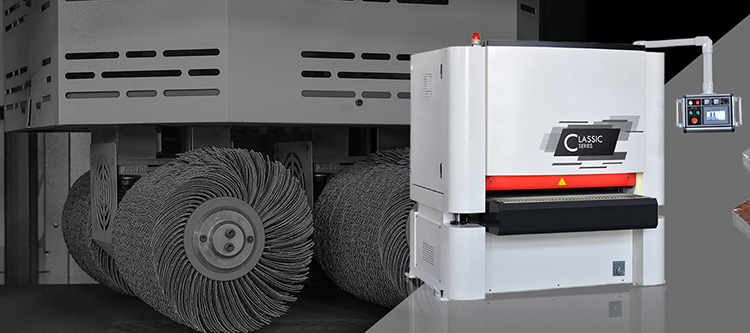
When reviewing machine builders, use this shop-floor engineering checklist:
For Wet Deburring Machines: Stopping Rust & Bearing Failure
Coolant mist and wet grinding sludge will destroy generic components. Verify these protective specs:
- All-304 Stainless Wet Zones: Spray bars, internal sumps, and fluid manifolds must be built from genuine grade 304 stainless steel—never painted carbon steel that chips and rusts.
- Positive-Pressure Spindle Seals: Standard rubber seals fail under high-pressure coolant. Quality wet units isolate spindle bearings behind mechanical labyrinth seals backed by positive air barriers to stop moisture penetration.
- 3-Stage Settling Tanks: Single screens clog instantly. Demand a multi-stage settling tank where heavy slag settles out first, preventing coarse metal grit from recirculating and scratching cosmetic parts.
For Dry Deburring Machines: Stopping Belt Jams & Fire Hazards
Dry grinding produces airborne fines and sparks, while aggressive belts can send small laser-cut parts flying:
- Active Spark Arrestors: If you deburr aluminum or mix materials, standard baghouse filters invite flash fires. Ensure the dry dust collector includes certified inline spark traps rated for air transport velocities over 25 m/s.
- Vacuum Bed Hold-Down: Spring-loaded pinch rollers struggle on small brackets under 100 × 100 mm. A high-flow vacuum belt locks small parts down to 50 × 50 mm flat against the conveyor, preventing parts from tilting into the grinding drum.
- Auto Pneumatic Retract: Look for contact drums with automatic pneumatic lifts. If a power outage or E-stop triggers mid-cycle, the grinding head retracts instantly to prevent deep gouging on the sheet and save the belt.
6. Which Should You Choose: Wet or Dry Deburring Machine?
Cutting through the noise comes down to your part mix and downstream finishing line. Match your shop floor against these everyday fabrication scenarios:
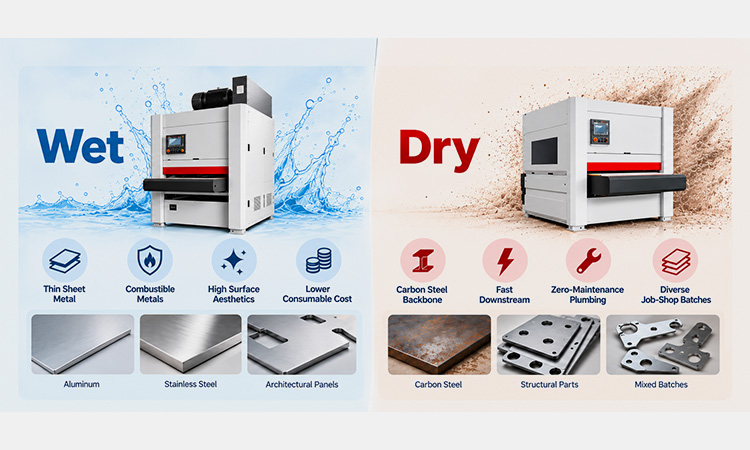
Choose a Wet Deburring Machine If:
- You run thin sheet metal (< 2.0 mm): Continuous coolant stops thermal warping, edge curl, and blue heat tint on lightweight aluminum or stainless.
- You process combustible metals: High volumes of aluminum or titanium are quenched on contact, eliminating airborne explosive dust risks without secondary scrubbers.
- Surface aesthetics are non-negotiable: You produce architectural panels, dairy tanks, or food-grade equipment requiring clean No.4 or hairline (HL) finishes.
- You want lower monthly consumable spend: Fluid lubrication prevents abrasive loading, stretching belt and brush life by roughly 30% to 50%.
Choose a Dry Deburring Machine If:
Your backbone is carbon steel: You need aggressive laser slag removal, mill-scale stripping, and heavy edge radiusing on structural plate.
Downstream speed is priority #1: Parts exit warm and dry, ready for instant robotic welding, press brake forming, or powder coat prep.
You want zero-maintenance plumbing: No coolant refractometers, no tramp oil skimming, no sludge shoveling, and zero wastewater handling.
You run diverse, non-reactive job-shop batches: Paired with a high-flow vacuum bed and spark arrestors, dry units offer maximum daily versatility.
The Bottom Line: Wet or Dry Deburring Machine?
Pick wet for thin sheets, aluminum dust safety, and premium cosmetic finishes (No.4 / Hairline). Pick dry for heavy carbon steel slag, immediate downstream welding or coating, and simpler daily upkeep.
Still weighing the trade-offs between wet and dry deburring for your production requirements?
Send us your part dimensions, material grades, and edge requirements. Our engineers will review your drawings, run sample parts through our test cells, and recommend the exact head configuration (wide belt, rotary brush, or combination) to optimize your shop floor output.
Frequently Asked Questions (FAQ): Wet vs. Dry Deburring
Q1: Do I need special sewer drainage or environmental permits for a wet deburring machine?
▼
No dedicated floor drain is needed for daily operations.
Modern wet deburring systems operate on a closed-loop internal settling tank that continuously recirculates filtered fluid. You only need a standard water inlet to fill the tank and top off for evaporation. However, when emptying spent fluid (typically 2 to 4 times a year), the oily wastewater and metal sludge must be disposed of according to local EPA or industrial environmental guidelines.
Q2: Can I retrofit or convert a dry deburring machine into a wet system later?
▼
No, dry machines cannot be converted to wet.
Wet and dry chassis are completely different from the ground up. A wet machine requires all-304 stainless steel fluid zones, sealed electrical enclosures, IP-rated washdown motors, and positive-pressure labyrinth bearing seals. Pumping liquid coolant into a standard dry chassis will cause severe structural corrosion, bearing seizure, and electrical short-circuits within weeks.
Q3:How do shop climate and freezing winter temperatures affect machine choice?
▼
In unheated fabrication facilities or regions with sub-freezing winters, a dry deburring machine is practically immune to climate swings. Wet machines require freeze-protection protocols: leaving water-based coolant sitting in internal spray manifolds, pumps, or valves over an unheated winter weekend can freeze and burst the plumbing. If your shop freezes overnight, dry deburring eliminates that risk.
Q4:What is the minimum sheet thickness each machine can handle?
▼
Both systems can feed parts down to 0.5 mm thickness when equipped with a proper hold-down conveyor. However, on gauge sheets between 0.5 mm and 1.5 mm, a wet deburring machine delivers significantly better flatness because continuous coolant prevents friction heat from curling thin edges or causing thermal warping.
Q5: How often do you need to change coolant in a wet deburring machine?
▼
Typically every 3 to 6 months, depending on your daily shift volume and material mix. Maintaining the right oil-to-water dilution ratio with a refractometer weekly and scooping out settled metallic swarf will extend coolant life and prevent bacterial odors.
Q6: Can a single deburring machine remove heavy slag and apply cosmetic surface graining?
▼
Yes, using a multi-station configuration.
A multi-head layout combining an aggressive contact roller (R drum) for initial slag knockoff with trailing planetary brush units (B/W heads) or non-woven Scotch-Brite rollers allows you to strip laser slag, round edges, and produce uniform hairline graining in a single conveyor pass.
Ready to elevate your production quality?
Investing in a high-quality sanding machine is a decision that impacts your manufacturing precision and efficiency for the next 5 to 10 years. Don’t settle for instability. Choose a reliable partner to secure your competitive edge in surface finishing.