
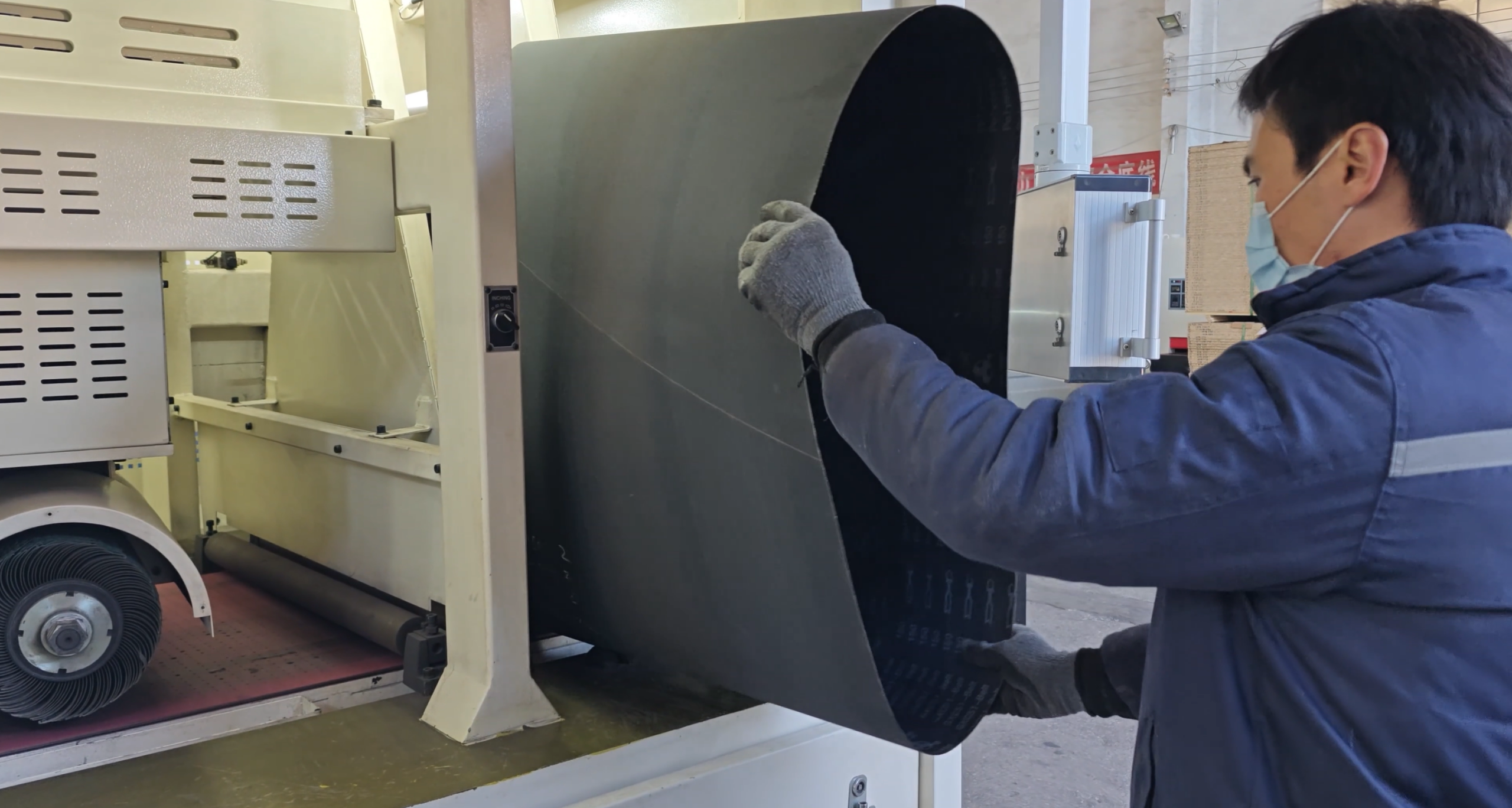
Sanding belt stability is one of the most critical factors in ensuring safe and precise industrial sanding performance.
Hi, I am Joanna. This episode, we come to discuss the stability of sanding belts.
It’s no exaggeration to say that the sanding belt is the core tooling in brush sanding machines or planer sanders.They are used to remove oxide, wear, scratches or marks, and they can achieve a certain level of surface finish. Due to its extremely high speed, about 12-30m/s (subject to different materials and finish surfaces), any uneven surface or unbalanced forces may cause belt deviation- belt run-off.
And belt run-off may result in:
- Damage to sanding belt. The fierce friction, scratches and tearing at a high speed will tear the sanding belt apart immediately.
- Wastage of workpieces and surface defects.
- Damage to the core parts of the machine. Wear and scratches to the tension rubber roller and pressure roller, machine frame deviation, overheating bearings and damage to the main shaft.
- Safety hazards. The sanding belt flying out may hurt people. Overheating caused by friction may cause smoke or fire. The swing system may stick and trigger an emergency stop.
- Permanent damage to precision. Frequent belt run-off will deform the machine frame and rollers, which is hard to put them right again.
| Problem | Consequence |
|---|---|
| Belt run-off / deviation | Belt tearing and breakage at high speed |
| Uneven workpiece surface | Scratches and surface defects on workpieces |
| Continuous friction overload | Damage to rollers, bearings and spindle system |
| Overheating / friction | Smoke, fire risk and safety hazards |
| Repeated deviation | Permanent deformation of frame and precision loss |
One hand, the sanding belt meets run-off causes frequently (workpiece uneven surface, burrs or slags, dust or metal chips), run-off is inevitable. On the other hand, the result of belt run-off is serious, which requires, a real good manufacturer has the responsibility to solve this issue perfectly. Now, let’s see how does we Armpre do.
The deviation-correction system is a self-regulation loop, similar to modern automatic deburring machines using PLC-controlled precision systems. The concept is like us driving a car, we are using the steering wheel to rectify the car direction, keeping it in the lane. As soon as the light given out by the photoelectric sensor is partially screened by the deviated sanding belt, this situation is transmitted to the PLC simultaneously, Consequently, the PLC gives orders to the cylinder to correct the sanding belt. Since the sanding belt’s high speed, the photoelectric sensor must react promptly to correct the deviation.
| System Component | Function | Benefit |
|---|---|---|
| Deviation-correction system | Real-time belt alignment control | Prevents belt run-off during high-speed operation |
| PLC control system | Processes sensor signals | Enables fast and accurate correction response |
| Cylinder actuator | Executes mechanical correction | Ensures precise physical adjustment |
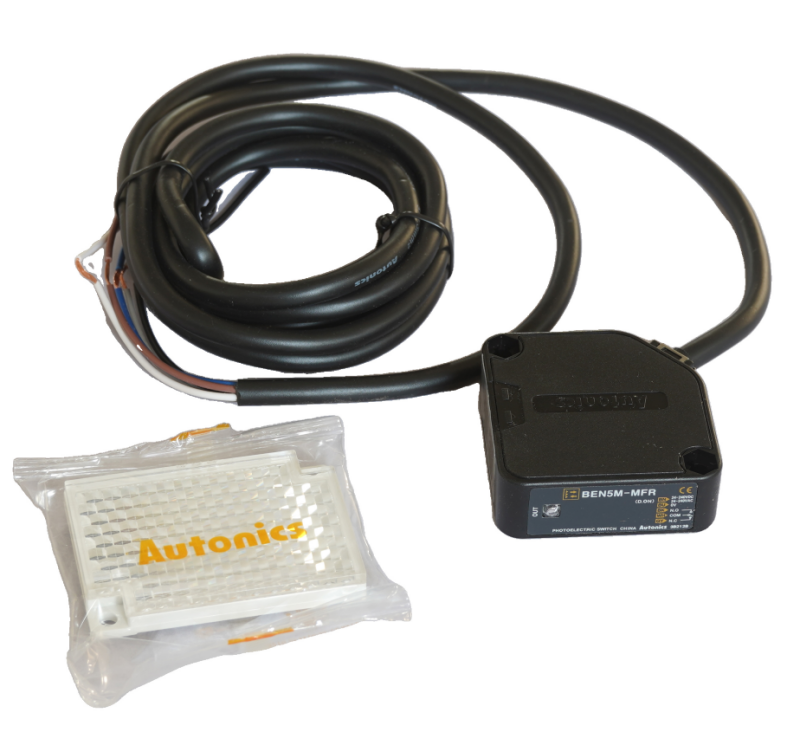
Let’s check out the photoelectric sensor we use- Autonics, South Korea.
- It’s able to capture the deviation in mm-level change, so as to make the cylinder work in a higher frequency and smaller movement. The deviated sanding belt will be corrected within a subtle distance, which seems to always stay in the middle position.
- Its high performance can precisely define the right position range of sanding belt.
- High anti-disturbance capability. A poor performance photoelectric sensor is easily blinded by high dense of dust or disturbed by the electromagnetic environment, and prone to make errors. Autonics, as one of the top-tier brands in the automation sector, with a well-sealed shell and perfect circuit design, is able to ensure its high performance even in dense dust and electromagnetic waves.
| Feature | Autonics Sensor | Generic Sensor |
|---|---|---|
| Detection precision | Millimeter-level accuracy | Centimeter-level or unstable |
| Response speed | High-frequency real-time response | Delayed response |
| Anti-interference | Strong dust & EM resistance | Easily affected by dust & EMI |
| Stability | High industrial-grade stability | Frequent errors in harsh environments |
This is one of the secrets that make our sanding belt stable in operation. I would be very glad to discuss other points with you.
See you next time.
Best Regards,
Joanna
Ready to elevate your production quality?
Investing in a high-quality sanding machine is a decision that impacts your manufacturing precision and efficiency for the next 5 to 10 years. Don’t settle for instability. Choose a reliable partner to secure your competitive edge in surface finishing.

About Joanna
As an industry specialist at ARMPRE, I focus on the technical evolution of industrial sanding and surface finishing. My goal is to bridge the gap between complex automation technology and practical manufacturing needs, helping clients achieve ±0.05mm precision and long-term ROI.