
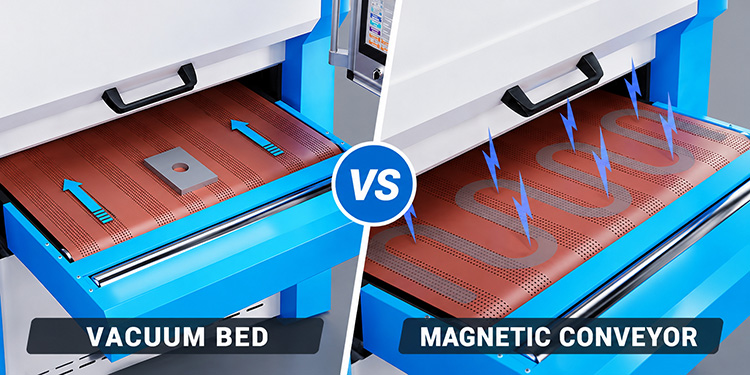
Small metal parts can be surprisingly difficult to handle during deburring. Even slight movement can affect the finish, especially with delicate or lightweight components.
That’s why choosing the right holding system matters.
Vacuum beds and magnetic conveyors both help keep workpieces stable, but they work differently. So, which one is better for your parts?
Let’s explore their differences and find the solution that best fits your material, part size, and finishing needs.
1. What Is a Vacuum Bed and How Does It Work?
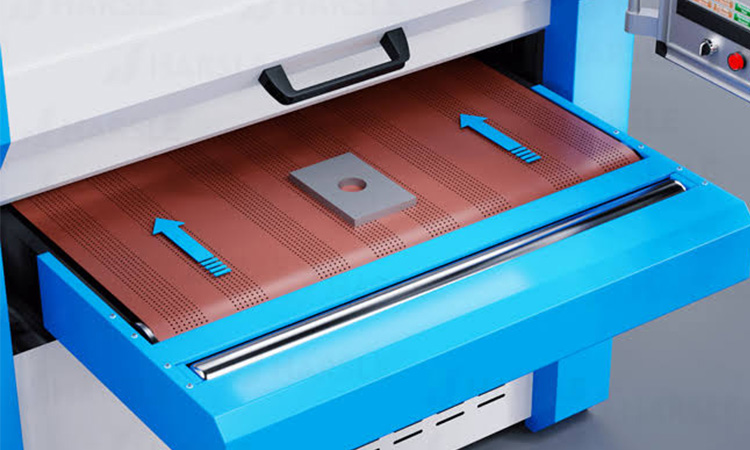
Imagine trying to keep a small aluminum part steady while a brush moves across its surface. Without proper support, even a little movement can affect the result.
A vacuum bed helps solve this problem by using suction to hold the workpiece against the conveyor surface. Unlike magnetic holding, it doesn’t depend on the metal’s magnetic properties.
This makes vacuum holding a practical option for carbon steel, stainless steel, and aluminum parts.
However, its effectiveness also depends on the contact area, part shape, and vacuum strength. Parts with large openings or uneven surfaces may need additional evaluation.
2. What Is a Magnetic Conveyor and How Does It Work?
For small carbon steel parts, magnetic holding offers another practical solution.
A magnetic conveyor uses magnetic force to keep ferromagnetic workpieces in place as they move through the deburring machine. This helps reduce unwanted movement during grinding and brushing.
However, not all metals respond to magnets. Aluminum and many stainless steel grades cannot be held effectively by conventional magnetic systems.
That’s why checking your material’s magnetic properties is an important first step before choosing this option.
3. Vacuum Bed vs. Magnetic Conveyor: Key Differences
Both vacuum beds and magnetic conveyors help keep metal parts stable during deburring. However, they use different holding methods, and each has its own strengths.
So, how do you know which one is right for your parts?
Let’s take a closer look.
| Vacuum Bed | Magnetic Conveyor | |
| Holding Method | Uses vacuum suction | Uses magnetic force |
| Suitable Materials | Carbon steel, stainless steel, aluminum | Mainly carbon steel and other ferromagnetic metals |
| Small Parts | Verified down to 50 × 50 mm | Verified down to 50 × 50 mm |
| Workpiece Thickness | Holding depends on contact area, flatness, and effective suction | Material thickness and magnetic properties may affect holding force |
| Perforated Parts | Openings may reduce effective suction | Depends on material magnetism, geometry, and available holding area |
| Grinding and Brushing Forces | Requires sufficient suction to resist processing forces | Requires sufficient magnetic holding force to resist processing forces |
| Daily Maintenance | Check suction openings, vacuum system, and relevant filters | Check the conveyor surface, metal debris accumulation, and mechanical components |
| Key Consideration | Effective contact area and vacuum strength | Material magnetism and holding force |
Which One Should You Choose?
If you mainly process carbon steel parts, a magnetic conveyor may be a practical starting point.
If you work with aluminum, non-magnetic stainless steel, or different materials, a vacuum bed may offer greater flexibility.
However, material alone doesn’t determine the best solution. Workpiece thickness, contact area, geometry, and finishing requirements also matter.
The most important thing is finding a holding system that keeps your parts secure throughout the process.
4. How Does the Holding System Affect Deburring Quality?
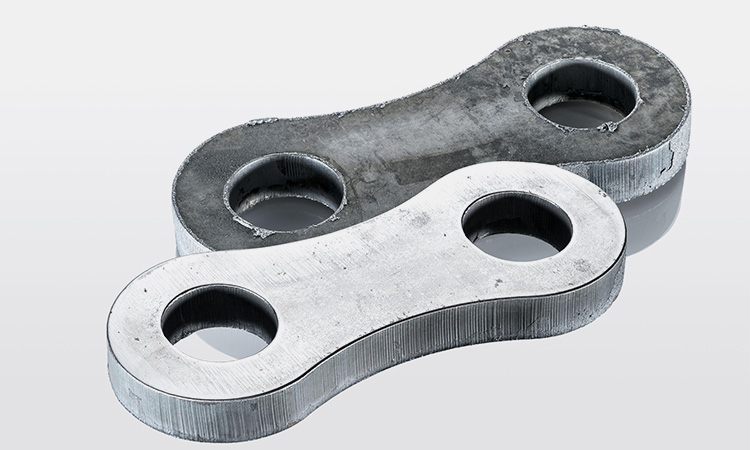
A good finishing result starts with keeping the workpiece steady.
During deburring, abrasive belts and brushes apply force to the metal surface. If a small part moves unexpectedly, the result may become uneven, and its edges may not receive consistent treatment.
That’s why choosing a holding system isn’t just about moving parts through the machine. It’s also about supporting a stable finishing process.
Whether you choose vacuum suction, magnetic holding, or pressure rollers, the goal remains the same: keeping your parts secure while the machine does its work.
Stable holding is only one part of the finishing process. If you’d like to understand how different grinding and brushing methods work, explore our guide to deburring technologies.
5. Which Holding System Is Best for Different Metals?
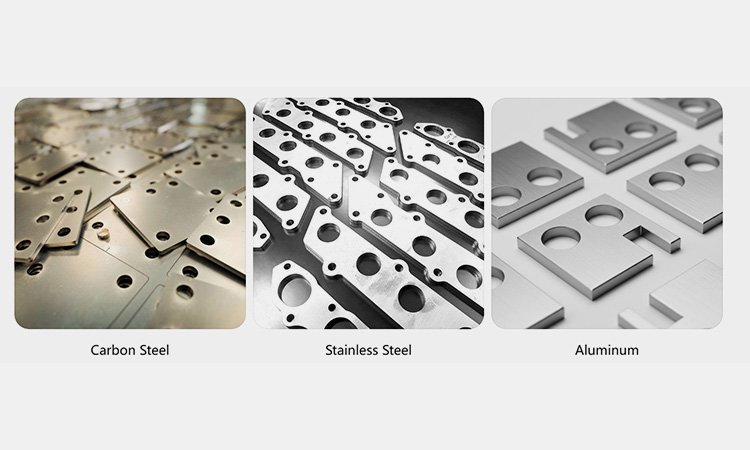
Different metals behave differently during deburring, so the right holding system often starts with understanding your material.
Carbon Steel Parts
Carbon steel is generally magnetic, making magnetic conveyors a practical choice. Vacuum beds and pressure rollers are also available, depending on the workpiece size and processing requirements.
Stainless Steel Parts
Not all stainless steel is magnetic. For non-magnetic grades, a vacuum bed or pressure rollers may be a better option. If you’re unsure about your material’s magnetic properties, check before deciding.
Aluminum Parts
Aluminum is non-magnetic, so conventional magnetic holding isn’t suitable. Instead, vacuum beds or pressure rollers can help keep aluminum parts stable during deburring.
For aluminum workpieces, you can also explore our aluminum deburring machines to learn more about suitable finishing solutions.
Ultimately, there’s no single solution for every metal. The best choice is the one that suits your material and keeps your parts secure throughout the process.
6. Can Vacuum and Magnetic Systems Handle 50 × 50 mm Parts?
When working with small metal parts, even a few millimeters can make a difference. A workpiece needs to remain stable while grinding belts or brushes remove burrs and finish its edges.
At ARMPRE, we’ve verified that vacuum beds, magnetic conveyors, and pressure roller configurations can handle workpieces as small as 50 × 50 mm under tested conditions.
But size alone doesn’t tell the whole story.
Two parts with the same dimensions may behave differently depending on their material, thickness, shape, and the forces applied during deburring.
For example, a flat carbon steel part and a perforated aluminum part may require different holding solutions, even if both measure 50 × 50 mm.
That’s why we recommend evaluating unusual or delicate workpieces individually.
Have a small part you’re unsure about? Share its dimensions, material, thickness, and a drawing or sample with our team. We’ll help assess which holding configuration best suits your application.
If you’re looking for equipment designed to handle compact workpieces, explore our small parts deburring machines.
7. When Should You Consider Pressure Rollers Instead?
Sometimes, a simpler holding method is all you need.
Pressure rollers help keep metal parts in place by applying mechanical pressure as they move through the deburring machine. Unlike vacuum beds or magnetic conveyors, they don’t rely on suction or magnetic properties.
For carbon steel, stainless steel, and aluminum parts, pressure rollers can be a practical option when the workpiece dimensions and processing conditions allow.
However, very thin, delicate, or irregularly shaped parts may require extra care to ensure stable handling.
The right choice isn’t always the most advanced system. It’s the one that works reliably for your parts.
8. What About Thin, Perforated, and Irregularly Shaped Parts?
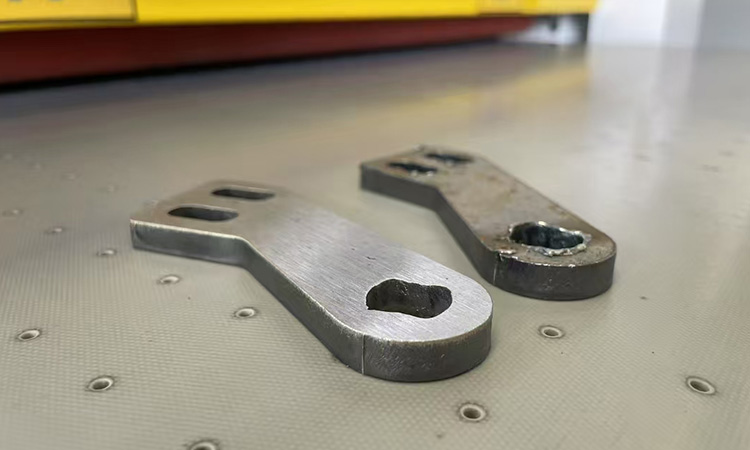
Perforated metal parts with slotted holes may require additional evaluation
Not every metal part has a simple, flat shape. Some are thin, full of holes, or have irregular edges, making them more challenging to hold securely.
For vacuum beds, holes and uneven surfaces may reduce suction. Magnetic conveyors depend on the material’s magnetic properties and the available holding area. Pressure rollers also need sufficient contact to keep parts stable.
If your workpieces have unusual shapes, there’s no need to guess which system will work best.
Sharing a drawing or sample with the ARMPRE team can help us evaluate your parts and recommend a suitable holding solution.
9. How to Choose the Right Workpiece Holding System
Choosing the right holding system doesn’t have to be complicated. Start with a few simple questions about your workpieces:
Material: Are your parts made of carbon steel, stainless steel, or aluminum?
Size and Thickness: How small or thin are the parts you need to process?
Part Geometry: Do they have holes, narrow sections, or irregular shapes?
Finishing Requirements: Do you need burr removal, edge rounding, or surface finishing?
Your answers will help narrow down the options.
If stainless steel is part of your production, our stainless steel deburring machines provide another useful starting point for exploring material-specific solutions.
Here’s a simple guide to help you narrow down your options.
| Your Workpiece or Requirement | Where to Start |
| Small carbon steel parts | Consider a magnetic conveyor |
| Stainless steel or aluminum parts | Consider a vacuum bed or pressure rollers |
| Different metals in daily production | Evaluate a holding system that supports your material range |
| Thin or perforated parts | Check the available holding area and workpiece stability |
| Heavy burrs or demanding finishing processes | Verify holding stability under actual processing conditions |
At ARMPRE, vacuum beds and magnetic conveyors are available as optional configurations, allowing the holding system to be selected according to your application.
And if you’re still unsure, we’re happy to review your drawings and help you find a suitable solution.
10. What Should You Consider Before Investing in a Holding System?
Choosing a holding system is an important decision, especially when your production involves small, thin, or unusually shaped metal parts.
Before making your choice, it’s worth checking a few details that can make a real difference during deburring.
Workpiece Material and Dimensions
Start with the basics: material grade, length, width, and thickness. These details help determine whether vacuum suction, magnetic holding, or pressure rollers should be considered.
Part Shape and Contact Area
Does your workpiece have holes, narrow edges, or an uneven surface? These features may affect how securely it can be held during processing.
Deburring Requirements
Removing light burrs and performing more demanding grinding operations may place different forces on the workpiece. The holding system should be evaluated under the intended processing conditions.
Production Volume and Material Variety
Think about the parts you process every day. Do you work with one material or several? Are your workpiece dimensions consistent, or do they change frequently?
These details can help you choose a configuration that better supports your production needs.
Sample Testing
For challenging workpieces, a sample test can be especially helpful.
Rather than relying on dimensions alone, testing under representative processing conditions can help assess workpiece stability and finishing results before a configuration is finalized.
At ARMPRE, we’re happy to review your drawings, samples, and processing requirements to help identify a suitable holding solution.
A little preparation today can make your equipment selection much easier tomorrow.
Conclusion:
There’s no single holding system that’s right for every metal part.
A vacuum bed offers flexibility across different materials, while a magnetic conveyor can be a reliable option for ferromagnetic parts. What matters most is finding a solution that suits your workpieces and finishing needs.
At ARMPRE, we understand that every production challenge is a little different. If you’re unsure which option to choose, feel free to share your drawings or requirements with us.
We’re here to help you find a solution that works for you.
Frequently Asked Questions (FAQ):
Q1: Can a magnetic conveyor hold stainless steel parts?
▼
It depends on the stainless steel grade. Some grades are magnetic, while others are not. For non-magnetic stainless steel, a vacuum bed or pressure rollers may be a better choice.
Q2:Is a vacuum bed suitable for aluminum parts?
▼
Yes. Vacuum beds can hold aluminum without relying on magnetic properties. However, part size, shape, and available suction area still affect holding stability.
Q3:What is the minimum workpiece size ARMPRE can handle?
▼
ARMPRE has verified a minimum workpiece size of 50 × 50 mm with its vacuum bed, magnetic conveyor, and pressure roller configurations under tested conditions. Special workpiece shapes may require further evaluation.
Q4:Can vacuum beds hold perforated or irregularly shaped parts?
▼
Possibly, but it depends on the design. Large openings or uneven surfaces can reduce effective suction. Sharing a drawing or sample helps determine whether vacuum holding is suitable.
Q5: Are vacuum beds and magnetic conveyors available on the same deburring machine?
▼
ARMPRE offers both as optional configurations, depending on the machine model and application requirements. This does not necessarily mean the two systems can be switched freely after installation
Q6: Is a magnetic conveyor always better than a vacuum bed for carbon steel?
▼
Not necessarily. Although carbon steel is generally suitable for magnetic holding, a vacuum bed or pressure rollers may also work well. The best choice depends on the workpiece dimensions, geometry, and finishing requirements.
Ready to elevate your production quality?
Investing in a high-quality sanding machine is a decision that impacts your manufacturing precision and efficiency for the next 5 to 10 years. Don’t settle for instability. Choose a reliable partner to secure your competitive edge in surface finishing.