
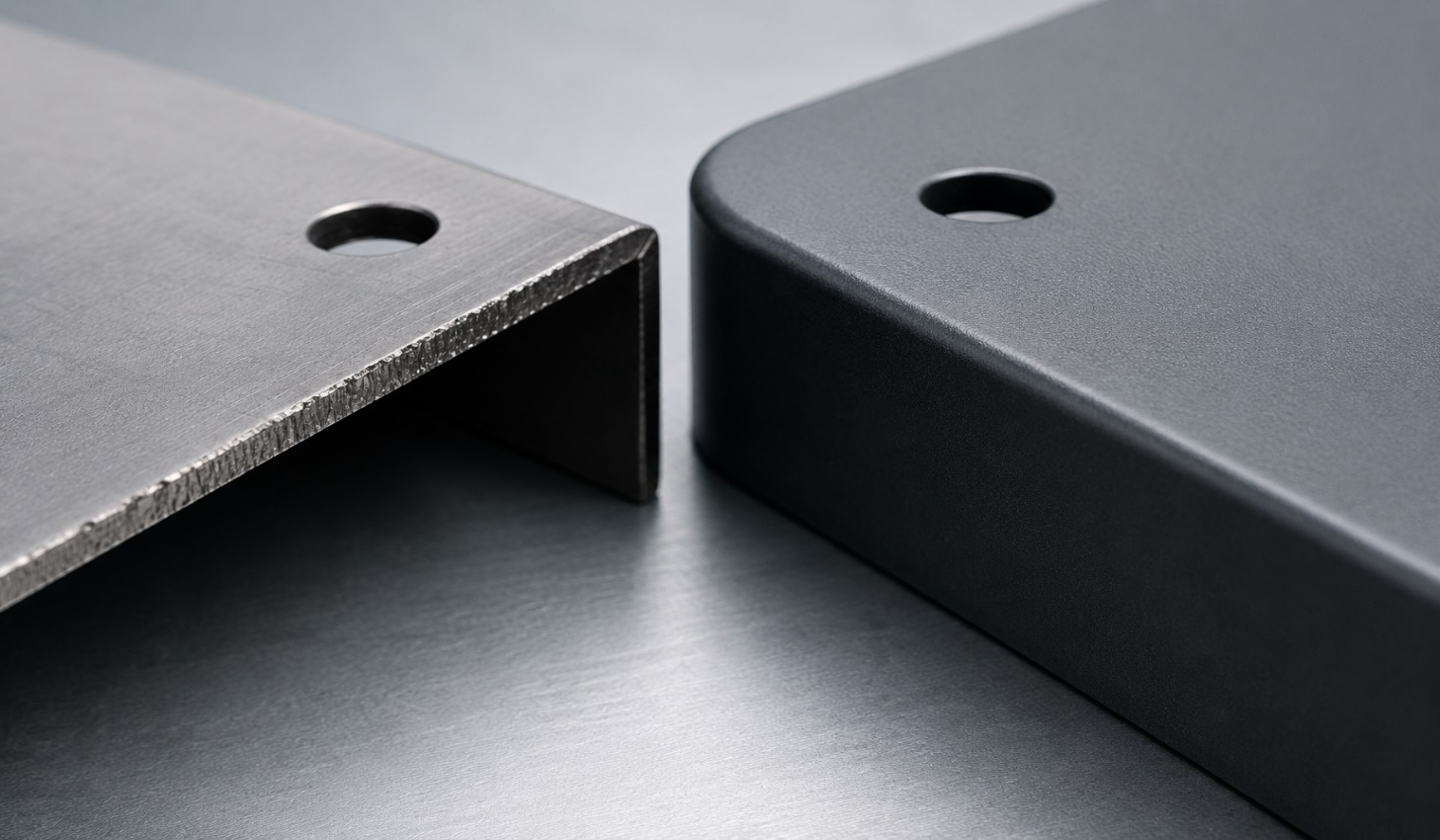
Edge rounding improves powder coating adhesion by creating a controlled edge radius that allows uniform coating thickness and stronger mechanical bonding. In modern sheet metal manufacturing, precision edge preparation is essential for achieving long-lasting coating durability and corrosion resistance.
Coatings are one of the most common types of finishes used when producing metal using sheet metal, because they offer high durability against corrosion, look better, and protect the surface of components that will be used on automotive, electrical, machinery, and industrial applications.
Unfortunately, coatings are often not applied evenly around the edge of the component and manufacturers have a lot of coating problems around the edge, such as:
- Peeling at the edge of the coating.
- Poor adhesion of coating to the part
- Thickness of coating material not being uniform across the entire part
- Coating having premature cracking or chipping
The question is; Why do coatings tend to have defects around the edge and not on flat surfaces?
The answer is related to the edge of the part. The shape and condition of the edge of the part directly affect how powder will be distributed over the part, and how the coating will perform on the part. Therefore, how a manufacturer prepares the edge of the part is extremely important in order to prepare it for the amount of powder they will put on the part during the coating process.
Without proper preparation of the edge of the part, then even if the coating material is of the highest quality, the performance or durability of the coating material on the part would not be optimal. Therefore, deburring the edge prior to powder coating, and finishing the edge with precision prior to coating, have become standard parts of the manufacturing and most modern processes.
1. What Is Edge Rounding?
Rounding edges is a finishing operation used in sheet metal processes to remove sharp corners and have a controlled radius on the edges of an item. This operation is typically done after laser cutting, punching, or plasma cutting.
For example:
A sharp edge has a narrow, jagged corner with burrs and stress concentrations.
The edge of a round part has a smooth radius that allows for more even paint application and more durable finish.
Some of the normal processes used to prepare the edge of a part are:
- Deburred
- Edge break
- Precision edge round
Parts that have been cut with laser or plasma will typically have sharp edges (and oxide layers) at this point. Both defects negatively affect subsequent coating.
To automate this process and get consistent results, many manufacturers use an edge rounding machine. The best machines provide precision edge rounding of both sides of the material and will give you the best surface finish and repeatability.
2.Why Sharp Edges Cause Powder Coating Failure
While powder coating offers superior protection, the sharp edges tend to be the weakest points of a completed product.
By understanding the failure mechanism for these areas, it will help demonstrate the importance of preparing the sheet metal edges properly for adherence of powder coating and longevity.
· Uneven powder distribution
Powder accumulates unevenly on sharp edges. As a result, the coating may be unable to provide even coverage of the edge. The resulting effects of this phenomenon will be:
- Edge coverage will not be adequate.
- The thickness of the coating will vary greatly.
- The coating will wear out and corrode earlier than if it were applied evenly across the edge.
The thin coating on edge tips often results in a lack of adherence of the powder to the metal.
· Electrostatic effect limitation
The process of powder coating relies on electrostatic attraction to help bind the particles of powder to the surface of the metal.
The presence of sharp edges distorts the electrostatic field caused by the powder and decreases the amount of powder that can adhere to the edge. These areas create weak spots and provide a greater chance for the coating to be damaged.
· Mechanical weak points
A sharp edge on a piece of sheet metal creates an area of high stress concentration. As the metal is bent, assembled, transported, or subjected to vibration, the coating will be subjected to elevated stress levels and is at a greater risk for cracking and peeling.
It is important to point out that while the thickness of the coating may be acceptable, the durability of the coating can be compromised due to the sheet metal edge.
3.How Edge Rounding Solves the Problem
· Improved powder flow
The powder particles will have improved flow and distribution due to their rounded edges. Some of the advantages to this improved flow and distribution include:
- More consistent surface coverage
- Greater adhesion
- Fewer coating defects
· Stable coating thickness
Elimination of very thin coating edges by precise rounding of edges allows for uniform coating thickness that results in:
- Greater corrosion resistance
- More pleasing to the eye
- More consistent product from batch to batch
- Improved Mechanical Bond Strength
· Better mechanical bonding
By rounding the edges of the profile, you reduce stress concentrations, which will help make the coated components more resistant to:
- Impact
- Vibration
- Assembly Stress
- Thermal Expansion
Edge rounding machines are designed specifically to provide consistent and precision edge rounding, which helps to improve the durability of the coating.
4. Comparison: Sharp Edge vs Rounded Edge
From weak and prone to fall off to a durable, long lasting coated Finish. The following table shows how sharp edges do not perform like rounded edges; it explains clearly why edge preparation is important in getting a good, long- lasting powder coat.
This comparison is a good illustration of how important it is to round the edges of the sheet metal beforehand and then powder coat.
5. Role of Edge Rounding Machines
In recent decades, Industrial Edge Finishing has moved away from manual grinding processes to systems that are highly automated.
· How industrial edge rounding machines work
Edge rounding machines use a mechanical process to remove the sharp edges and smoothen them to a uniform rounded shape in metal. The process typically includes:
Feeding metal piece
Sheet metal parts are set on a feeding table or a conveyor.
The part is automatically guided through the processing zone by the machine.
Abrasive tools in contact with edge
While the sheet is progressing, it goes through rotating or oscillating tools.
These tools take away sharp burrs and slightly reshape the edge.
Uniform rounding action
There are multiple contact points to treat all edges (top, bottom, inner cutouts), evenly.
This means that there will be a consistent radius rather than a sharp 90° edge.
Surface refinement
In advanced machines, secondary stations can be used to smoothen the surface and eliminate micro-defects and oxidation.
Output
The finished part has better, smoother, and coating edges.
· Typical technologies:
Edge rounding machines remove burrs, and create a radius on the edge of a part using specialized abrasive technology. The most common technologies are:
- Rotary Brush Systems
Rotating brushes remove burrs while creating a smooth edge radius.
Benefits:
- Very efficient
- Works on a variety of materials
- Produces high-quality surface finishes
- Abrasive Belt Systems
Using an abrasive belt is the ideal method for controlled material removal and precision applications.
Benefits:
- Consistent quality
- Increased throughput
- Lower labor costs
Most manufacturers use a double-sided Edge Rounding Machine that will process two sides of the part at the same time, which increases production efficiency significantly.
6.Precision Edge Rounding in Industrial Production
Round edge finishing is an important finishing procedure for the production of sheet metal parts that need a uniformly rounded edge with high accuracy. It is necessary for any industrial product requiring edge rounding to ensure that all aspects of product safety, coatings, and mechanical performance are controlled.
· Importance of precision edge control
Even a slight imperfection on the edge of a part can have a significant negative impact on a company’s finished product. Precision edge control provides:
- Consistently controlled edge radii across all manufactured parts
- Better adhesion of painted and powder coated finishes
- Less stress at the corner created by a sharp edge
- More dependable handling of parts during assembly and shipping
- Greater longevity and consistent quality of all manufactured parts
· Application in:
- Automotive parts
Precision edge rounding is used extensively on automotive sheet metal components to provide a safer and more aerodynamic shape and help improve the performance of the coatings applied to these components. This is essential to ensure that both body panels and structural components meet demanding quality and durability requirements.
- Electrical cabinets
Sharp edges on electrical cabinets can create issues with cable damage and create safety hazards. Using precision edge rounding to create smooth edges on the inside and outside of electrical cabinets improves electrical insulation safety and long-term reliability.
- machinery enclosures
Industrial machinery requires heavy-duty protective housings. Rounded edges help reduce wear on rounded surfaces, reduce the potential for cracking on coated surfaces, and improve operator safety when performing maintenance or handling the equipment.
· Double-sided edge rounding advantage
The process of double-sided edge rounding allows for both the upper and lower edges of a flexible material to be rounded in one operation. This provides:
- Faster product throughput
- A consistent edge quality on both sides
- Consistent coating adhesion on both faces
- Lower manual finishing costs
Greater compatibility with automated production processes
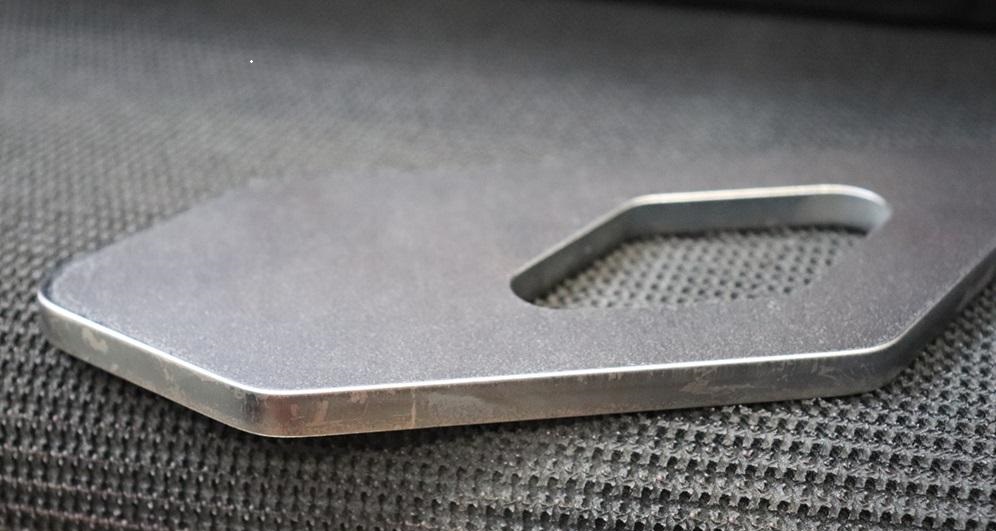
7.Edge Rounding Before Powder Coating Workflow
To obtain good bonding (and achieve a good bonding ratio) of your powder coating to a metal part will take more than just applying the powder coat. A well-structured surface preparation process will create clean edges, uniform thickness, and durability of the coating over the life cycle of the product.
There are step-by-step process and usual sequence of an efficient finishing operation is:
1. Laser cutting or punching
The creation of parts occurs per the drawings.
2. Deburring
Burrs and sharp edges are eliminated from parts.
3. Edge rounding
Controlled radii are created to enhance coating performance.
4. Oxide removal/dust removal
Oxide removal on laser or plasma cut parts is critical. All types of surface residuals and contaminants from the parts must be removed before coating.
A dry deburring machine can be used that combines:
- Deburring
- Oxide removal
- Surface finishing
- Edge rounding
5. Powder coating
Powder is deposited over the part by an electrostatically charging process.
6. Curing
Cure powder at a high temperature to melt and bond powder to each part, creating a durable protective layer over the part.
8.Benefits for Manufacturers
Edge rounding before powder coating results in significant benefits for manufacturers in terms of efficiency, quality and long-term profitability.
1. Higher coating yield rate
Properly prepared edges allow the powder to adhere evenly over the entire surface (including corners and edges) thus resulting in fewer defects (peeling, thin spots and uneven coverage) and a higher percentage of parts that meet quality standards on the first attempt.
2. Reduced rework cost
Coating failures can create high costs due to rework, labor and material waste. Incorporating deburring/edge rounding into manufacturing processes minimizes the number of rejections and reduces overall operational costs while providing manufacturers with consistent quality.
3. Improved product appearance
Rounded edges offer a smooth, uniform coating. Parts that are powder coated after a proper deburring/edge rounding process have a cleaner, more professional appearance and fewer visible defects therefore enhancing customer satisfaction and building brand loyalty.
4. Compliance with quality standards
A variety of industries have set quality standards for coatings (performance, corrosion resistance and surface finish). By using precise edge rounding, manufacturers achieve greater consistency in coating thickness and adhesive strength which supports compliance with customer specifications and industry-based quality standards.
5. Longer product lifespan
Parts that have superior powder coating adhesion and lower stress concentration are more durable than similar parts that do not have as much of either characteristic. Individual components are more protected from corrosion, impact, and day-to-day wear, which provides longer service life to those components and less maintenance or replacement costs to the user.
Conclusion:
Edge rounding has become necessary in today’s sheet metal manufacturing to effectively provide consistent adhesion and good long-term performance of products as a result of a quality powder coat application. Rounding edges, plus eliminating sharpness, provides a controlled radius that allows for a uniform thickness of powder coating to be applied, as well as for the enhancement of durability through minimizing defects and thus reducing the need for costly rework.
Manufacturers are utilizing advanced technology such as precision edge rounding and automated edge rounding systems to create continuous consistency of quality and efficiency of production.
Industrial edge rounding solutions and dry deburring systems significantly improve the quality of products produced by expanding product life and creating better surface finishes to all types of processes performed on laser cut and/or complex sheet metal components.
For more details about industrial edge rounding’s equipment and solutions, visit Armpre.com.
Selecting the right edge rounding solution depends on your material type, production volume, and coating quality requirements. If you are currently evaluating suppliers or planning to upgrade your finishing line, our engineering team recommends reviewing this comprehensive industry analysis to compare the world’s leading deburring machine manufacturers.
👉 Just Have A See: Top 10 Deburring Machine Manufacturers: 2026 Global Sourcing Guide
FAQ
Q1: What is edge rounding in sheet metal?
▼
The process of edge rounding is performed to provide a smoother radius at all edges and corners of sheet metal, thus improving the safety, quality of the coating, and longevity of the product.
Q2:Why is edge rounding important before powder coating?
▼
When edges are rounded, they assist in equalizing the coating thickness during application and reducing the potential of peeling off, cracking, and adhesion failures once the coating has cured.
Q3: Can edge rounding improve powder coating adhesion?
▼
Yes, the edge being rounded offers greater powder distribution, which greatly increases adhesion of the powder coating to the metal surface.
Q4: What is the difference between deburring and edge rounding?
▼
Removing burrs is accomplished through deburring, while edge rounding improves coating quality by giving a controlled radius to the edge of an object that will be coated, thus improving its performance and longevity.
Q5:Do laser-cut parts need edge rounding before coating?
▼
Absolutely! Laser cut parts often have very sharp edges and also develop oxide layers after they have been cut. It is necessary to treat all of these issues before applying powder paint.
Q6:What machine is used for edge rounding in industry?
▼
Typically, there are two types of machines that manufacturers use for edge rounding:
- Edge rounding machines
- Double sided edge rounding machines
Most edge rounding machines use either rotary brush technology or abrasive belt technology.
Q7:Can edge rounding improve coating durability?
▼
Definitely! Edge rounding generally helps to extend coating life by reducing stress concentration and providing a uniform thickness of the coating.
Q8:What materials can be processed by edge rounding machines?
▼
The list of materials that can be processed by an edge rounding machine include:
- Carbon steel
- Stainless steel
- Aluminum
- Galvanized steel
- Copper
Non-ferrous metals
Ready to elevate your production quality?
Investing in a high-quality sanding machine is a decision that impacts your manufacturing precision and efficiency for the next 5 to 10 years. Don’t settle for instability. Choose a reliable partner to secure your competitive edge in surface finishing.

About Smaria
I am a technical specialist at ARMPRE, dedicated to mastering the art of industrial surface finishing. I focus on bridging the gap between sophisticated automation and real-world manufacturing, ensuring every workpiece achieves consistent edge perfection and a flawless finish that maximizes your long-term ROI.