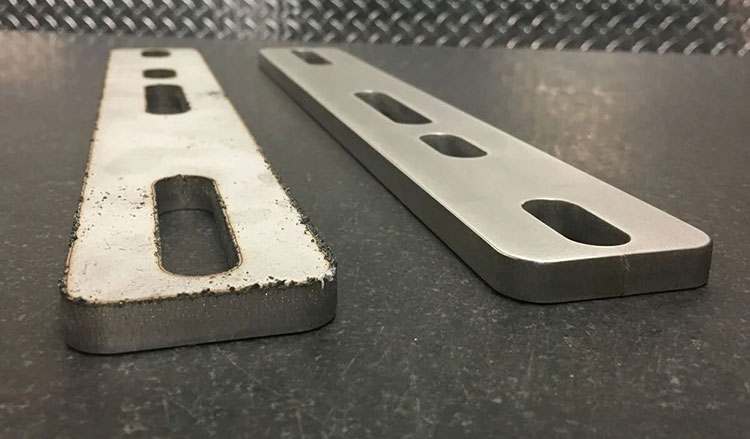
If you cut carbon steel with oxygen, you know that dark crust on every cut edge: laser oxide scale.
Leave it on, and powder coating peels off within weeks, while welding cells face porosity and failed seams.
Many fabricators immediately think: “Why not use a laser cleaning gun to blast it away?”
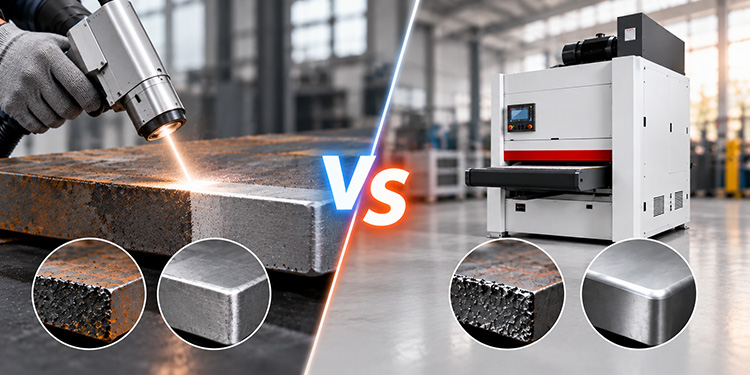
Laser cleaners sound modern, but are they fast enough for daily production? Or does a conveyorized mechanical deburring and edge rounding machine make more sense for real shop volume?
To help you choose the right setup without wasting budget on the wrong bottleneck, let’s break down what actually happens to both machines when real production volumes hit your shop floor. Explore this laser oxide removal guide now.
1. What Is Laser Oxide, and Why Does It Cause Paint to Peel and Welds to Fail?
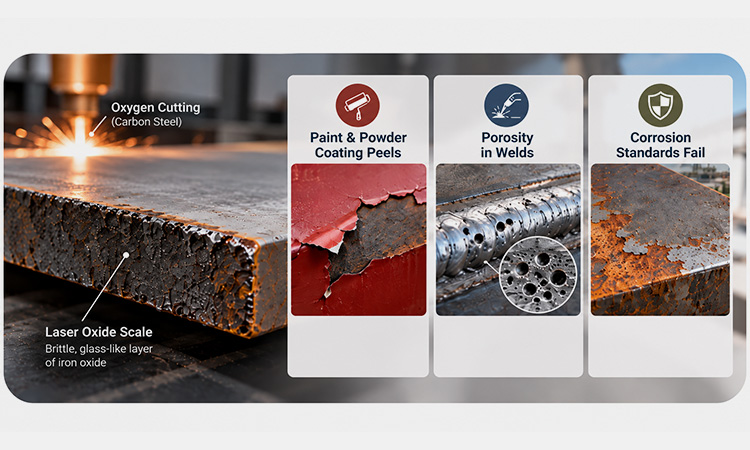
When you use oxygen assist gas to cut carbon steel, molten iron reacts with pure oxygen at extreme temperatures. This creates a brittle, glass-like layer of iron oxide along every cut edge.
Leaving this layer intact creates two major production bottlenecks:
- Paint & Powder Coating Peels: Paint bonds directly to the brittle oxide crust rather than bare steel. Over time, moisture slips underneath, the oxide cracks, and full sheets of paint flake off.
- Porosity in Welds: Trapped oxygen from the oxide scale vaporizes during welding, creating internal gas pockets and weak joints that fail inspection.
- Corrosion Standards Fail: European corrosion standards like EN ISO 12944 require clean, bare metal to achieve long-lasting outdoor rust protection.
2. How Laser Cleaning Works (The Pros vs. Speed Limits)?
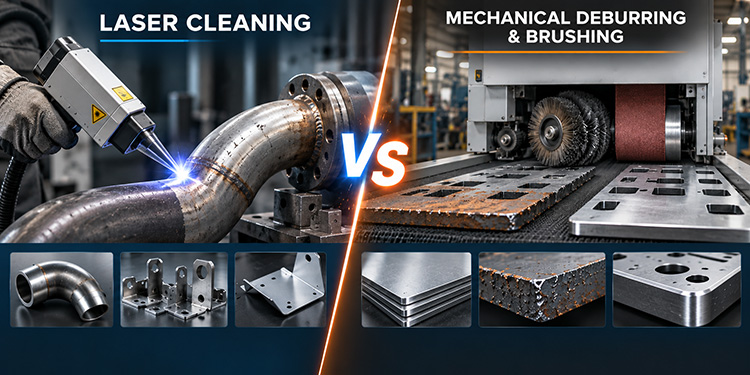
Laser cleaning uses high-frequency laser pulses to vaporize and burn off the surface oxide layer, exposing bare metal.
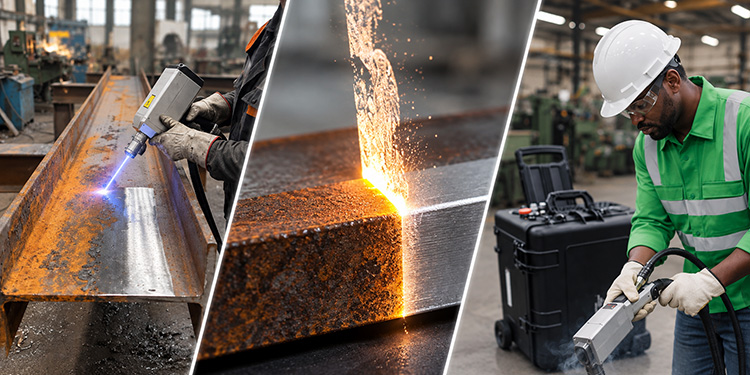
The Pros:
- Non-Contact: No physical impact or part distortion, making it safe for delicate or complex 3D parts.
- Consumable-Free: Requires no abrasive belts or wire brushes.
The Shop-Floor Bottlenecks:
- Slow Cycle Times: Cleaning is done square inch by square inch. Clearing hundreds of flat laser-cut parts creates severe production delays.
- High Labor Reliance: Handheld laser guns require an operator to trace every cut line manually.
- No Edge Rounding: A laser only removes the black scale. It leaves the 90-degree corner razor-sharp, where paint remains dangerously thin.
3. How Mechanical Brushing Strips Laser Oxide & Slag?
Mechanical machines use heavy-duty rotating steel wire brushes and abrasive belts to scour part contours physically.
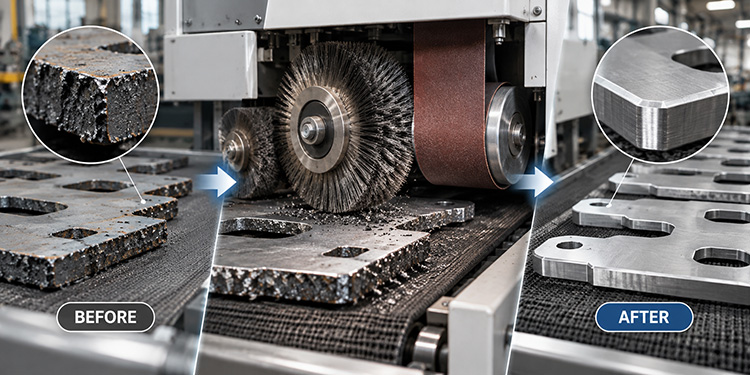
The Mechanical Advantages:
- Continuous Throughput: Parts sit flat on a conveyor belt moving at 1.5 to 4.0 meters per minute. It strips oxide from top, bottom, and cut edges in a single pass.
- Aggressive Slag Removal: Specialized rollers hammer away stubborn heavy dross and cutting slag that lasers cannot vaporize.
- Superior Mechanical Keying: High-speed wire bristles leave a microscopic cross-hatch texture on bare metal, boosting powder coating adhesion.
- Hands-Off Operation: Operators simply feed parts onto the belt, eliminating manual gun-tracing labor.
4. Laser Cleaning vs. Mechanical Brushing
To see how both methods stack up during real daily runs, here is the direct floor comparison:
| Laser Cleaning | Mechanical Deburring & Brushing | |
|---|---|---|
| Feed Speed | Slow (cm2/sec), point-by-point | High (1.5- 4.0 m/min continuous flow) |
| Part Geometry | Best for 3D shapes, pipes, tight spots | Best for flat, laser-cut nested sheet parts |
| Heavy Slag Removal | Weak; cannot blast thick melt dross | Excellent; hammers off heavy bottom dross |
| Edge Rounding (R2) | No; leaves razor-sharp 90° edges | Yes; simultaneously creates uniform round corners |
| Coating Prep | Strips oxide only; zero surface profile | Cleans oxide and keys metal for paint adhesion |
| Labor Demand | High manual gun tracing or robotic setup | Low; load and unload conveyor operation |
5. The Edge Rounding: Why Cleaning Oxide Alone Isn’t Enough
Stripping the black oxide scale is only half the battle. If your edge stays razor-sharp at 90 degrees, paint will still fail.
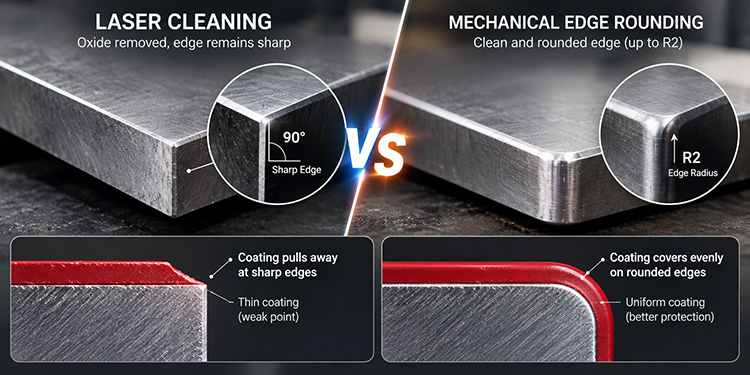
Liquid paints and powder coatings naturally pull away from sharp corners due to surface tension. Even on clean metal, the coating layer along a sharp edge is often less than one-third of the thickness on flat surfaces, leaving an easy target for edge corrosion.
- Laser Cleaning Limitation: A laser leaves the knife-like 90° edge completely untouched.
- The Mechanical Advantage: High-speed wire brushes and abrasive blocks knock down sharp rims into a smooth, uniform radius (up to 2.0 mm / R2).
- Meeting strict standards like EN ISO 12944 requires both bare metal and rounded edges. Mechanical finishing achieves both in one pass.
6. How to Verify Oxide Removal: 3 Simple Shop-Floor Tests
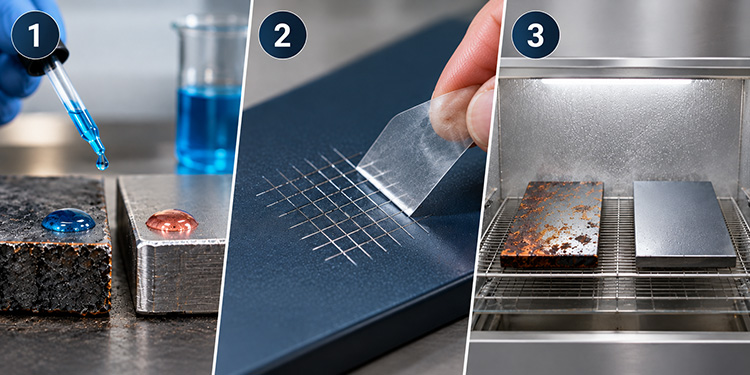
You do not need an advanced metallurgical lab to verify whether laser oxide is completely gone. Use these three straightforward floor tests:
- The Copper Sulfate Spot Test: Apply a drop of acidified copper sulfate solution to the cut edge. Bare, clean carbon steel instantly plates with a bright copper color. If dark oxide scale remains, no chemical reaction occurs.
- Cross-Hatch Tape Adhesion (ASTM D3359): Coat a test sample, scribe a lattice pattern across the edge, apply pressure-sensitive tape, and snap it off. High-quality prep achieves a 5B rating with zero paint flaking.
- Neutral Salt Spray Testing (ASTM B117): Place sample plates inside a salt spray chamber. Edges finished with mechanical brushing and an R2 radius easily survive 500+ hours without rust creep, whereas sharp laser-cleaned corners corrode rapidly.
7. Laser Cleaning vs. Mechanical Brushing: Which Machine Fits Your Shop?
Choosing the right technology comes down to part geometry and daily volume:
Choose Laser Cleaning When:
- 3D & Complex Parts: You finish curved stampings, pipe assemblies, or weld seams where flat belts cannot reach.
- Low Volume & Rework: You handle small, high-precision batches or occasional spot repairs.
- Fragile Materials: Parts are ultra-thin and cannot withstand any conveyor pressure.
Choose Mechanical Deburring & Brushing When:
- Flat Sheet Production: You process high volumes of flat, laser-cut carbon steel plates daily.
- Heavy Slag & Dross: Thick oxygen-cut parts need aggressive bottom dross stripped immediately.
- Two-in-One Efficiency: You need both oxide removal and an R2 edge radius in a single through-feed cycle.
- Strict Coating Standards: Your clients demand zero paint chipping on exterior equipment or structural frames.
8. The Real Running Costs: Laser Cleaning vs. Mechanical Oxide Removal
Laser cleaning is often marketed as “free to run” because it uses no abrasive consumables. In high-volume production, the true numbers tell a very different story:
- Equipment Investment: Industrial-grade pulsed laser stations (or multi-axis robotic cells) carry a massive entry price compared to proven, standardized mechanical deburring units.
- Cost Per Part: Handheld laser cleaning ties up costly skilled labor inch by inch. Mechanical through-feed systems process dozens of nested parts per minute on an automated conveyor, driving labor cost per part close to zero.
- Consumables vs. Overhead: While mechanical units require periodic brush replacements, those costs are predictable. Laser systems demand expensive protective optics, high power draws, and specialized dust-extraction filters.
- The Cost of Recalls: Skipping edge radiusing leads to field coating failures, field repainting, and warranty claims that far exceed any consumable savings.
The Bottom Line:
Laser cleaning is a precision scalpel for localized repairs, but an automatic sheet metal deburring machine remains the true workhorse for mass fabrication.
If your daily goal is stopping paint flaking on flat carbon steel without slowing down production, mechanical brushing delivers the throughput, slag removal, and R2 edge radiusing that laser heads cannot match.
Ready to Eliminate Laser Oxide and Edge Chipping? Send us your part drawings, material specs, or cutting samples. Our engineering team will run a free trial finish to show you how fast your edges can reach pristine, coating-ready standards.
Frequently Asked Questions (FAQ):
Q1: Can switching to nitrogen-assisted laser cutting eliminate the need for oxide removal?
▼
Yes, but it won’t solve your paint problems.
Nitrogen prevents oxidation entirely, but it is far more expensive than oxygen. More importantly, cut edges remain razor-sharp, still requiring edge radiusing to stop paint peeling.
Q2: Will mechanical wire brushes change the dimensional tolerances of precision holes?
▼
No.
Flexible steel wire brushes wrap around contours to strip brittle scale and knock off burrs without removing base metal or widening hole diameters.
Q3:Can laser cleaning handle heavy cutting dross or bottom slag?
▼
No.
Lasers only vaporize thin surface scale. Thick molten slag must be physically sheared off using abrasive contact drums or mechanical slag-grinding pins.
Q4:How quickly will bare parts rust after oxide removal?
▼
Without their oxide crust, raw carbon steel edges face flash rust. Parts should head to painting, plating, or dry indoor storage within 24 to 48 hours.
Q5: Does removing laser oxide create airborne health or fire hazards?
▼
Yes.
Brittle iron oxide dust is an airborne hazard whether vaporized by laser or brushed off mechanically. Both processes require wet dust extractors or spark-arrested collection systems.
Q6: Can an existing dry deburring machine be retrofitted with oxide removal brushes?
▼
Yes.
Most modular through-feed deburring machines can easily swap standard abrasive blocks for steel wire brushes to remove slag and strip oxide in a single automated pass.
Ready to elevate your production quality?
Investing in a high-quality sanding machine is a decision that impacts your manufacturing precision and efficiency for the next 5 to 10 years. Don’t settle for instability. Choose a reliable partner to secure your competitive edge in surface finishing.